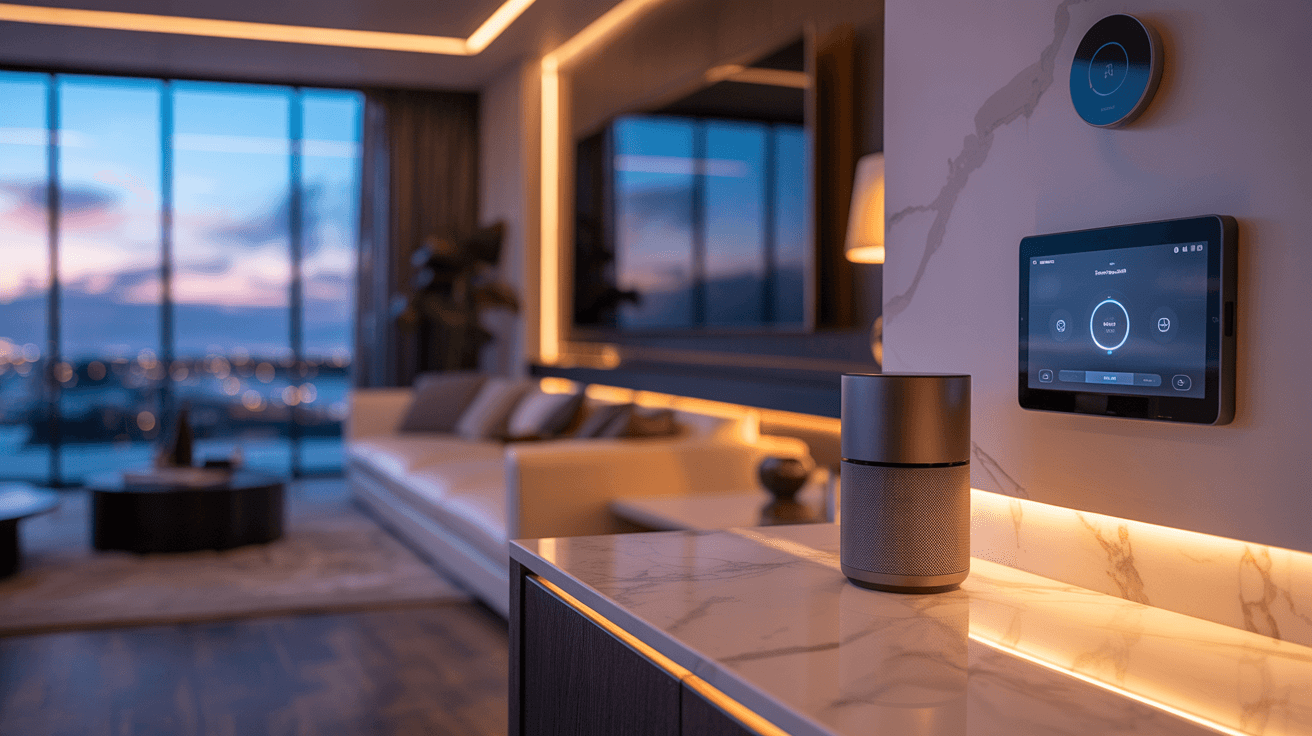
8 Best AI Agent Companies Powering the Next Generation of Smart Home Automation
The AI in smart home technology market hit $15.3 billion in 2024 and is projected to reach $104.1 billion by 2034, growing at a 21.3% compound annual rate. Over 57% of US households are expected to own at least one smart device by 2026, with the average connected home running 15 to 20 devices at once. Those numbers tell me the smart home is no longer a novelty. It is a booming category, and artificial intelligence is the engine behind it.
Smart homes are moving from reactive control, where you tap an app or bark a command, to proactive automation, where AI agents learn your patterns and adjust your environment before you even ask. Edge computing, the Matter protocol, and on-device machine learning are making this shift possible. In this article, I will highlight 8 companies building the AI agent technology that powers the next wave of smart home innovation.
Why AI Agents Are Changing the Smart Home Landscape
Traditional smart home setups depend on rules you program manually. If the temperature drops below 68 degrees, turn on the heat. If motion is detected after 11 PM, activate the alarm. These rule-based automations work, but they are rigid. AI agents replace that rigidity with adaptive intelligence.
An AI agent in a smart home context is software that observes sensor data, learns household patterns, makes autonomous decisions, and improves without reprogramming. According to GearBrain’s coverage of CES 2026, the industry is moving from adding AI to individual devices toward building cohesive, multi-device intelligence platforms:
Capability | Rule-Based Automation | AI Agent Automation |
Learning | None, manual setup | Learns habits, adapts over time |
Decision-Making | If-then triggers only | Context-aware, predictive |
Energy Optimization | Scheduled adjustments | Real-time pricing and occupancy aware |
Security Response | Fixed motion alerts | Distinguishes residents from intruders |
Device Coordination | Siloed per device | Cross-device orchestration |
Maintenance | Reactive, after failure | Predictive, alerts before breakdown |
That comparison captures why AI agents represent a generational leap for the connected home.
Leading AI Agent Development Companies Driving Smart Home Innovation
The companies on this list range from custom development firms building bespoke AI solutions to product-driven companies that have embedded agentic intelligence into their ecosystems.
1. LITSLINK
LITSLINK earns the top spot as a company that builds custom AI agents from the ground up for businesses across multiple verticals, including smart home and IoT. Their AI agent development services cover the full pipeline, from NLP-powered conversational agents and voice-enabled assistants to autonomous IoT controllers that process sensor data, manage connected devices, and optimize energy consumption in real time. With a 300-person engineering team, over 300 shipped products, and deep expertise in machine learning, computer vision, and edge computing, LITSLINK delivers AI solutions that connect to smart thermostats, security systems, lighting networks, and appliance ecosystems.
2. Josh.ai
Josh.ai is the gold standard for privacy-first AI voice control in luxury smart homes. Built on proprietary NLP, it integrates with Crestron, Lutron, Sonos, and Control4. The Josh Core hub processes everything locally, so voice data never leaves the home. Its knowledge graph technology handles complex, contextual commands across lighting, climate, and AV systems.
3. Amazon (Alexa AI)

Amazon has transformed Alexa from a voice assistant into an agentic platform. The Alexa+ upgrade handles multi-step tasks, remembers preferences across sessions, and coordinates routines across dozens of device types. With hundreds of millions of devices deployed globally, Amazon’s ecosystem remains the largest entry point into AI-powered home automation.
4. Google (Nest and Home AI)
Google’s Nest Learning Thermostat pioneered devices that learn your schedule and adapt autonomously. In 2026, the Tensor chip in Google’s speakers and displays runs on-device Gemini AI for near-instant responses without cloud trips. Google Home now uses presence detection and contextual awareness to adjust lighting, climate, and media proactively.
5. Samsung (SmartThings AI)
Samsung’s Bespoke AI lineup, highlighted at CES 2026, advances kitchen and laundry automation. AI Vision powered by Google Gemini lets the Family Hub refrigerator recognize food and suggest recipes. SmartThings connects appliances, sensors, and third-party devices into a unified platform that learns patterns and coordinates energy usage across the home.
6. Apple (HomeKit and Siri Intelligence)

Apple’s smart home AI centers on privacy. HomeKit processes automations locally on the Apple TV or HomePod, and Siri can recognize household members by voice, trigger personalized scenes, and work across Thread and Matter protocols. For homeowners in the Apple ecosystem, it offers a tightly integrated, security-first experience.
7. Savant
Savant builds AI-driven platforms for high-end residential properties, combining lighting, climate, entertainment, and security into one intelligent interface. The AI engine uses occupancy data and usage patterns to automate scenes and cut energy waste. Savant integrates deeply with Apple’s ecosystem and supports professional installation.
8. Home Assistant (Nabu Casa)
Home Assistant is the leading open-source smart home platform and a pioneer in local-first AI. The Green hub, paired with a Coral AI accelerator, runs fully local camera processing with zero cloud dependency. It supports over 2,000 integrations, including Matter, Zigbee, and Z-Wave, giving developers and power users unmatched flexibility.
What to Look for in an AI Agent Partner for Smart Home Projects
Whether you are a startup building a smart thermostat or an enterprise launching a whole-home platform, your development partner needs these capabilities. Based on GearBrain’s analysis of AI in smart homes, here is what matters most:
- Edge computing expertise for local data processing that minimizes latency and protects privacy
- Experience with IoT protocols like Matter, Thread, Zigbee, Z-Wave, and BLE for broad device compatibility
- NLP and voice AI capabilities for building agents that understand natural, multi-step commands
- Machine learning pipelines that let the system learn household patterns over weeks and months
- Security-first architecture with encryption, local storage, and GDPR/CCPA compliance
- Proven integration experience with thermostats, cameras, locks, lighting, and AV systems
Getting these fundamentals right during planning prevents costly rebuilds later.
Conclusion
AI agents are transforming the smart home from a collection of disconnected gadgets into a genuinely intelligent living environment. The companies on this list build technology that learns your routines, anticipates your needs, and manages your home with minimal human intervention.
If you are planning a smart home product or upgrading an existing platform, start by evaluating these companies. Look at their portfolios, ask about IoT and edge AI experience, and make sure they can deliver a solution that prioritizes performance, privacy, and reliability. The next generation of the smart home will be built on technology that works, not promises that sound good on a spec sheet.
