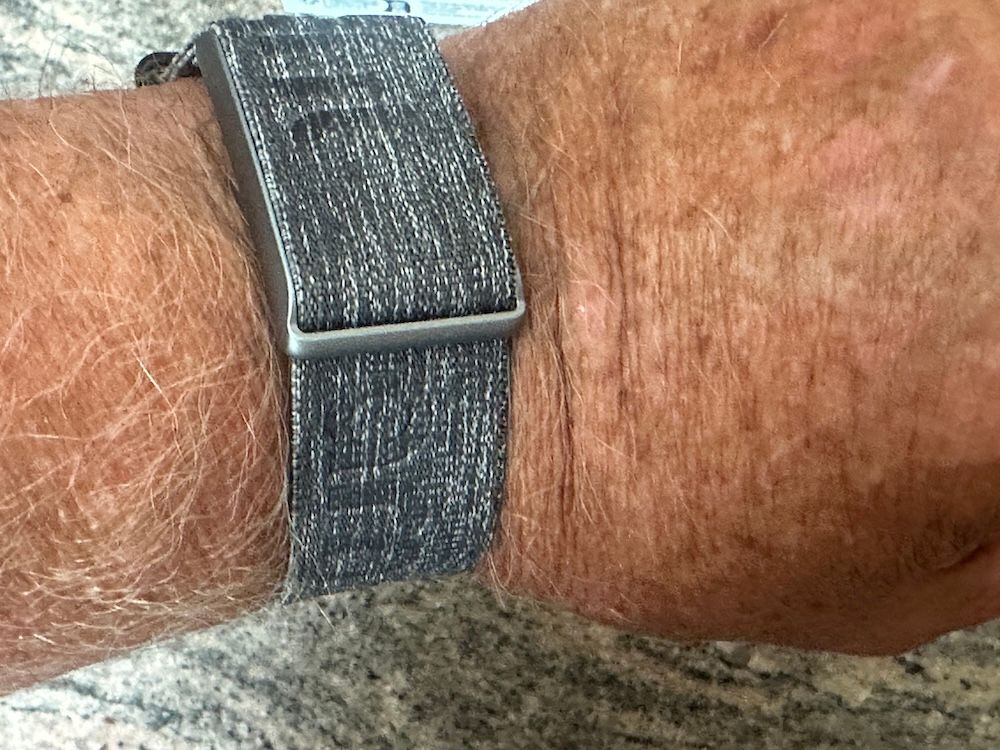
Amazfit Helio Strap Review: A Month of Testing This Screen-Free Fitness Tracker
Smartwatches can track almost everything these days, but not everyone wants another screen on their wrist. That's where the Amazfit Helio Strap comes in.
The Helio Strap is a screen-free health and fitness wearable designed to continuously collect information about your activity, heart rate, sleep, stress, and recovery. Instead of checking the wearable itself, you use Amazfit's Zepp app on your smartphone to view your health and workout data.
We tested the Amazfit Helio Strap for a month, wearing it during workouts, runs, golf, and everyday activities. We also tested it on both our wrist and upper arm to see how well it tracked our heart rate in real-world conditions.
After a month, we found the Helio Strap particularly appealing for users who want health and fitness tracking but don't necessarily want a smartwatch. Its $99.99 MSRP and lack of a required subscription also make it an interesting option in the increasingly competitive screen-free fitness tracker market.
But there are trade-offs. There is no display, so you won't be checking messages, controlling music or operating your smart home from your wrist. And as smart home users ourselves, we think Amazfit has an opportunity to make the health information the Helio Strap collects more useful in the connected home.
Here's what you need to know before buying.
What is the Amazfit Helio Strap?

The Amazfit Helio Strap is a lightweight, screen-free fitness and health tracker built around Amazfit's BioTracker 6.0 PPG biometric sensor.
It continuously monitors heart rate every second and can also track blood-oxygen saturation, stress, sleep, and other health metrics. Amazfit combines this information with activity and workout data in the Zepp app, where users can see trends and insights about their fitness, sleep, training, and recovery.
The Helio Strap supports more than 50 sports modes and can recognize 25 strength-training movements. It also offers real-time heart-rate broadcasting over Bluetooth and can store heart-rate information offline for up to 21 days.
The key difference from an Amazfit smartwatch—or an Apple Watch, Samsung Galaxy Watch or similar wearable—is immediately obvious: there is no screen.
That's intentional. The Helio Strap is designed to collect information rather than constantly demand your attention.
Amazfit Helio Strap key features
Some of the key features include:
- Continuous, second-by-second heart-rate tracking
- Blood-oxygen, stress and sleep monitoring
- BioCharge energy and recovery insights
- 50+ sports modes
- Recognition of 25 strength-training movements
- Real-time Bluetooth heart-rate broadcasting
- VO₂ max, training load, training effect and recovery information
- Wrist or upper-arm wear
- 5 ATM water resistance
- Up to 10 days of rated battery life
- Android and iOS compatibility
- Third-party fitness platform integrations
- No required monthly subscription
The Helio Strap's MSRP is $99.99, and Amazfit rates battery life at up to 10 days. It is available only in black.
Design and comfort
The Helio Strap differs from a conventional smartwatch. There's no watch face, touchscreen, crown or collection of buttons to learn.
The device weighs just 20 grams and measures 33.97 x 24.3 x 10.59mm without the sensor. The body uses fiber-reinforced polymer, while the 22mm nylon strap uses a hook-and-loop fastening system. It has a 232mAh battery and connects using Bluetooth 5.2/BLE.
You can wear the Helio Strap around your wrist, or position it on your upper arm for training.
We tested both.
For everyday use, the wrist works well. But for exercise—especially running—we preferred wearing the Helio Strap on our arm.
That position was comfortable and kept the tracker out of the way while giving us the health information we wanted.
Testing the Helio Strap's heart-rate tracking
Heart-rate tracking was one of the main reasons we wanted to test the Helio Strap.
Amazfit uses its BioTracker sensor to measure heart rate every second. According to the product information supplied to GearBrain, the arm-worn configuration is designed to reduce interference caused by wrist movement, flexing, gripping, and sweating during high-intensity exercise.
Over our month of testing, we used the Helio Strap while exercising, running, playing golf, and during other daily activities.
We found the heart-rate readings accurate and consistent during our testing. We particularly liked wearing the device on our upper arm when running.
Another useful feature is live heart-rate broadcasting. The Helio Strap broadcast our heart rate to the iPhone 14 Pro we used for testing, and we didn't experience connectivity problems between the tracker, phone and Zepp app.
You also don't have to take your smartphone with you every time you exercise. If you want to go for a run, walk or workout without carrying your phone, the Helio Strap can record activity information and sync it later.
That's important for a screen-free wearable. It means the tracker can largely disappear into the background while you're exercising.
Running and workouts

The Helio Strap makes a lot of sense for people who find smartwatches cumbersome during certain exercises.
Strength training is a good example. A watch on the wrist can sometimes get in the way when you're lifting, gripping equipment or performing exercises that heavily flex the wrist.
Amazfit designed the Helio Strap to support strength and high-intensity training, including rep, set, and rest-period tracking. There's also a dedicated HYROX Race mode.
The Zepp app provides post-workout information including VO₂ max, training load, training effect, and recommended recovery time.
The Helio Strap supports more than 50 sports modes, including running, walking, cycling, indoor workouts, ball sports, combat sports, swimming, and more. Options include outdoor running, treadmill, walking, HIIT, strength training, yoga, Pilates, tennis, pickleball, boxing, cycling and pool swimming.
That gives the Helio Strap considerably more versatility than simply functioning as a heart-rate monitor.
What about golf?
We also wore the Helio Strap while playing golf.
For us, its role on the golf course was primarily health and heart-rate monitoring. It allowed us to record the activity and see how our heart rate responded over the course of a round.
However, buyers shouldn't confuse the Helio Strap with a dedicated golf watch. It isn't designed to provide the on-course golf features you might expect from a GPS golf wearable.
If you're an Amazfit user specifically looking for more advanced golf tracking, the company's Balance 2 is the Amazfit wearable designed for that purpose.
For someone who simply wants to record the physical activity and health information associated with playing a round, however, the Helio Strap worked well for us.
Health, sleep and recovery tracking
The Helio Strap isn't only for workouts.
Amazfit's BioTracker system continuously monitors heart rate, blood-oxygen saturation, and stress. Sleep monitoring includes sleep stages, REM sleep, naps, sleep schedules, breathing quality, sleep score, and sleep heart-rate variability.
One of the more interesting features is BioCharge, Amazfit's approach to estimating your changing energy and recovery levels.
Rather than looking only at a workout in isolation, the system considers activity, exercise, stress, and rest to help you understand how prepared your body may be for additional activity.
That's ultimately one of the reasons to wear something like the Helio Strap throughout the day and night. The more consistently it collects information, the more complete the picture of your activity and recovery can become.
Zepp app and third-party fitness integrations
Because there's no display, the Zepp app is an especially important part of the Helio Strap experience.
The app is where you view and analyze the information the tracker collects. It also brings together workout, nutrition, health and recovery information and provides AI-driven insights.
We have used Zepp with other Amazfit products and continue to find it one of the more comprehensive fitness and health apps available.
The Helio Strap can also fit into a broader fitness ecosystem. Zepp supports data synchronization with services including Strava, adidas Running, TrainingPeaks, Komoot, Relive, Google Fit and Apple Health.
That flexibility is useful if you've already accumulated years of health and fitness information elsewhere.
The smart home opportunity Amazfit is missing
Here's one area where we think Amazfit could do more.
If you like controlling your smart home from your wearable, the Helio Strap is not the device for you.
There's no display, which means you can't glance down and turn off a smart light, adjust your thermostat, check a camera notification or control another connected device the way you might from a compatible smartwatch.
That's understandable because the Helio Strap isn't trying to be a smartwatch.
But we think there's a bigger opportunity in the Zepp app itself.
During our testing, we wished Zepp offered smart home integrations that could combine health information from the Helio Strap with information and controls from connected home devices.
Imagine your wearable detecting that you're hot or that your heart rate remains elevated after a workout, and then incorporating information from your smart thermostat or air conditioner. Or imagine combining sleep and respiratory information with readings from a connected air-quality monitor or smart air purifier.
A smart home could potentially become more responsive when health and environmental information work together.
The Helio Strap already collects a significant amount of personal health information. Connected homes increasingly collect environmental information. Bringing those two types of data together could create some interesting possibilities.
We hope Amazfit explores this area in the future.
For now, though, buyers should think of the Helio Strap as a health and fitness wearable, not a smart home controller or smartwatch replacement.
Battery life: better than Amazfit's rating in our testing
Amazfit rates the Helio Strap for up to 10 days of typical use from its 232mAh battery.
Interestingly, we did even better.
During our testing, we got more than two weeks of use on a single charge.
Battery life will naturally vary depending on monitoring settings, workouts and usage, but our experience was impressive.
Removing the display undoubtedly helps here. There isn't a bright touchscreen waking throughout the day, and you don't need to worry about charging the device every night.
That makes the Helio Strap easier to use for sleep and recovery tracking because you aren't constantly deciding when to take it off and recharge it.
Water resistance
The Helio Strap carries a 5 ATM water-resistance rating.
That makes it suitable for sweating, showering, and shallow-water swimming. There's also a pool-swimming sports mode.
However, it's not designed for diving or high-pressure water activities. In other words, swimmers and triathletes can incorporate it into many training routines, but we wouldn't recommend it for scuba diving.
No subscription required
One of our favorite things about the Amazfit Helio Strap is something you don't have to buy: a recurring subscription.
The Helio Strap works with the Zepp app and provides access to its health, training, recovery, and performance information without requiring a monthly subscription.
That's an important consideration when comparing the real cost of health wearables.
At $99.99, you're buying the hardware without automatically committing yourself to another recurring monthly or annual expense just to get useful information from the device.
What are buyers saying about the Amazfit Helio Strap?
Buyer reaction to the Helio Strap has been largely positive, although experiences aren't universal.
As of our review, Amazfit's U.S. site shows a 4.7 out of 5 rating based on 277 reviews. Buyers frequently mention comfort, battery life, sleep information, and the usefulness of having a screen-free fitness tracker.
Best Buy buyers are similarly positive, with the Helio Strap currently showing 4.8 out of 5 from eight reviews. Verified purchasers have praised its heart-rate tracking, sleep information, battery life, recovery data and lack of a monthly subscription. One reviewer, however, said the algorithms and optical sensors could still be improved.
Longer-term user discussions are a little more mixed, which is worth considering. Some Helio Strap owners on Reddit report reliable HRV and resting-heart-rate tracking, comfortable upper-arm wear and eight-to-10-day battery life. Others have reported inconsistent automatic workout detection, occasional sleep-tracking problems or frustrations with how information is transferred to other health platforms.
Those comments also align with some professional testing. Other reviewers have generally found the Helio Strap's heart-rate performance strong for its price, while noting that automatic workout detection can be inconsistent.
Our own experience with heart-rate monitoring was positive, particularly when wearing the Helio Strap on the upper arm.
Amazfit Helio Strap specifications
| Specification | Amazfit Helio Strap |
|---|---|
| Price | $99.99 MSRP |
| Display | None |
| Weight | 20g |
| Color | Black |
| Sensor | BioTracker 6.0 PPG biometric sensor |
| Heart-rate tracking | Continuous, every second |
| Sports modes | 50+ |
| Strength exercises recognized | 25 |
| Water resistance | 5 ATM |
| Battery | 232mAh |
| Rated battery life | Up to 10 days |
| GearBrain test battery life | More than two weeks |
| Connectivity | Bluetooth 5.2/BLE |
| Storage | 32MB |
| Offline HR storage | Up to 21 days |
| Android | Android 7.0 and above |
| iPhone | iOS 15.0 and above |
| App | Zepp |
| Subscription required | No |
What we liked
After a month with the Helio Strap, its simplicity became one of its biggest strengths.
We liked the continuous heart-rate monitoring, especially when we wore the tracker on our upper arm for running and workouts. Connectivity with our iPhone and Zepp app was reliable during our testing, and live heart-rate broadcasting worked as expected.
Battery life was another highlight. Getting more than two weeks of battery life in our usage exceeded Amazfit's up-to-10-day specification.
We also appreciate the large selection of supported activities, extensive health information available through Zepp and the ability to use the tracker without paying a monthly subscription.
Most importantly, the Helio Strap doesn't pretend to be something it isn't. It isn't another miniature smartphone strapped to your wrist.
It's a health and fitness tracker.
What could be better
The lack of a screen will be either a benefit or a drawback depending on what you want from a wearable.
You can't check the time, read messages, see incoming calls or control smart home devices directly from the Helio Strap.
We'd also like to see Amazfit expand Zepp beyond the traditional fitness ecosystem. Smart home integration could make health information more actionable by connecting it with products such as smart air purifiers, thermostats, air conditioners, and indoor air-quality monitors.
Because so much of the experience depends on software, continued improvements to workout recognition and the interpretation of health and recovery data will matter.
Who should buy the Amazfit Helio Strap?

The Helio Strap makes the most sense for someone who wants to understand their fitness, heart rate, sleep, and recovery without wearing a smartwatch.
We think it's particularly well suited for:
- Runners who want continuous heart-rate information without a watch
- Gym users and strength-training enthusiasts
- People who prefer wearing a tracker on their upper arm
- Athletes interested in training and recovery information
- Users who don't want notifications and another screen on their wrist
- Buyers who want a screen-free fitness tracker without a required subscription
- Existing Amazfit users who already use the Zepp ecosystem
It could also be useful for someone who already wears a traditional watch but still wants continuous health information.
On the other hand, if you want apps, notifications, GPS information on your wrist, music controls or smart home controls, you should look at a smartwatch instead.
GearBrain verdict
After testing the Amazfit Helio Strap for a month while running, working out, playing golf, and going through normal daily activities, we came away impressed with what this simple wearable does.
The heart-rate monitoring worked well in our testing, and we especially liked wearing it on our upper arm while running. The extensive health information in Zepp, large selection of sports modes, and excellent battery life make it easy to wear without constantly thinking about the device.
The $99.99 price is also attractive, particularly because there's no required subscription.
We would like to see Amazfit take the Zepp ecosystem further. Combining health information with smart home environmental data could open the door to genuinely useful automations involving air quality, temperature, sleep, and recovery. Right now, though, that's an opportunity, not a Helio Strap feature.
And that's really the key to understanding this product.
The Amazfit Helio Strap is not a smartwatch—and that's the point.
If you're looking for a screen-free wearable that can track heart rate, workouts, sleep, and recovery without adding another display to your life or another subscription to your credit card, the Helio Strap is a compelling option at $99.99.
Check out our smart home compatibility find engine, to see the other compatible smart locks that work with Google Assistant and Amazon Alexa-enabled devices.
