
8 AI Agent Companies Powering the Next Generation of Smart Home Automation
Walk into a smart home from 2020, and the trick was that the lights came on when you told them to. Walk into one in 2026, and the lights come on because the house worked out you were almost at the door. That gap — between a home that obeys and a home that anticipates — is the whole story of where smart home AI is headed. And it turns out a surprisingly short list of companies is writing it.
The money says the shift is real. The AI in smart home technology market was worth $15.3 billion in 2024 and is projected to reach $104.1 billion by 2034 — a 21.3% compound annual growth rate, according to InsightAce Analytic. That's the market roughly seven-x'ing in a decade, which means the companies that own the intelligence layer now are the ones their competitors will be paying to license later. Adoption is fuzzier, and worth being honest about: estimates range from Parks Associates' figure of 45% of internet-connected US households owning at least one smart device, to industry numbers putting it closer to 57% by 2025, depending on who's counting and what they count. The average connected US home now runs somewhere between 16 and 21 devices, though most of those are phones, laptops, and TVs rather than purpose-built smart-home gear.
Numbers like that tell you the category stopped being a novelty. What they don't tell you is who's building the intelligence underneath it. Below are eight companies doing exactly that — some you hire to build a custom agent, some you buy off the shelf or run yourself.
What Changes When the House Stops Waiting to Be Told
Most smart homes today run on rules somebody typed in once and then forgot. If the temperature drops below 68, turn on the heat. If motion trips after 11 PM, sound the alarm. These work fine, right up until life refuses to follow the rule. The heat kicks on for an empty house. The alarm screams at the cat.
An AI agent is the alternative: software that monitors sensor data, learns a household's patterns, makes its own calls, and improves without anyone rewriting the logic. The difference is the one between a metronome and a jazz drummer. One keeps perfect time. The other reads the room.
The Matter protocol, edge computing, and on-device machine learni ng are what make the second thing possible. GearBrain's coverage of CES 2026 made the shift plain: the industry is moving away from bolting AI onto individual gadgets and toward systems where many devices share one brain.
Capability | Rule-Based Automation | AI Agent Automation |
|---|---|---|
Learning | None, manual setup | Learns habits, adapts over time |
Decision-Making | If-then triggers only | Context-aware, predictive |
Energy Optimization | Scheduled adjustments | Real-time pricing and occupancy aware |
Security Response | Fixed motion alerts | Distinguishes residents from intruders |
Device Coordination | Siloed per device | Cross-device coordination |
Maintenance | Reactive, after failure | Predictive, alerts before breakdown |
That table is the case for AI agents on one screen. The harder question is who you trust to deliver any of it.
How These Eight Were Chosen
A quick word on method, because the version of this article that crowns a single best smart-home company — and lines up a custom development studio, a $150 hub, and a luxury install platform as if they're all chasing the same buyer — is the version nobody should trust. These companies are not running the same race.
So I split them by the only distinction that actually helps a reader decide: do you hire them to build something, or do you buy what they've already built? One name here — LITSLINK — is a development partner. The other seven are platforms, hubs, and products you can purchase or run yourself. Ranking those two groups head-to-head on a 1-to-8 scale would be like ranking a contractor against a hardware store. Both matter. Neither replaces the other.
Inside those buckets, the bar for making the list was concrete:
- Shipping, not slideware. Every agentic feature named here is live in 2026, not a promise on the roadmap. Aqara's spatial-intelligence sensors and its first Matter camera were on the floor at CES 2026. Homey shipped a version that lets outside AI agents control the home. Hubitat added AI-assisted automations to its hubs in early 2026.
- Interoperability. Real support for Matter, Thread, Zigbee, or Z-Wave, because an agent that only talks to its own brand is a walled garden, not a smart home.
- Local and privacy posture. How much runs on-device, and what happens to your data when it doesn't.
- Track record you can verify. A delivery history or an install base you can actually check. Home Assistant reports 500,000+ active installs and 2,800-plus integrations; Homey works with 50,000-plus devices across more than 1,000 brands; Hubitat supports 1,000-plus devices across 100-plus brands; LITSLINK lists 500+ shipped projects and a 4.8 rating across 70-plus Clutch reviews.
The order below is not a ranking. LITSLINK comes first because it's the odd one out — the company you call before any of the others exist inside your product. After that, the seven platforms appear in no particular hierarchy, because the right one depends entirely on what you already own and what you're trying to build. A renter with three smart bulbs and a developer launching a connected-appliance line are not shopping for the same thing, and pretending that one answer fits both is how buyer's guides lose readers' trust.
LITSLINK

Start with the part of the market nobody buys at retail: the company you hire when the agent you need doesn't exist yet.
LITSLINK is a US-based custom software and AI firm that has been building complex systems since 2014, with 300+ engineers across machine learning, data engineering, backend, and security, and 500+ projects shipped across eight-plus industries. Its AI agent development services cover the full build — NLP-driven conversational and voice agents, multi-agent systems, and autonomous controllers that ingest sensor data, coordinate connected devices, and tune energy use in real time.
For a smart home or IoT company, that's the relevant skill set. Not a shelf product, but a partner who builds the agent that becomes your product. LITSLINK is model-agnostic — it works across Claude, GPT, Gemini, Llama, and others rather than betting the house on one, which matters more than it sounds, given the model you picked in January is rarely the best one available by December. It's the only name here you engage rather than install, which is exactly why it sits first: a different category of company, not a higher rung on the same ladder.
Josh.ai

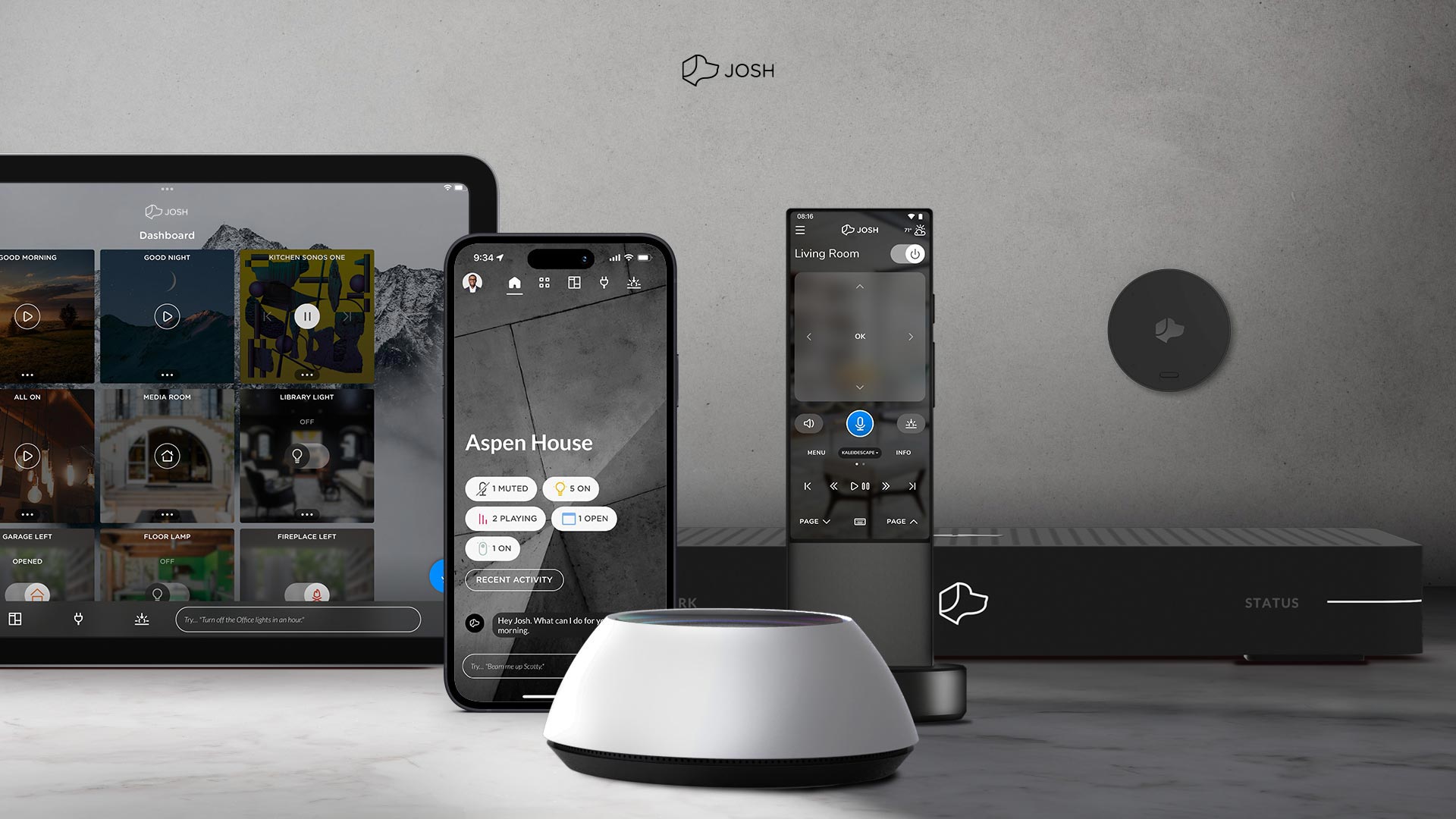
Josh.ai built its name on a specific bet: that people with expensive homes don't want a mass-market assistant listening inside them. It's a voice-control platform aimed at the luxury and custom-install market, integrating with professional systems like Crestron, Control4, Lutron, Sonos, and Savant — more than 100 brands in all — and pulling them under one natural-language interface. Tell it to "make it cozy," and it dims the Lutron shades, warms the lights, and starts the music in a single move.
Its pitch is privacy. Josh doesn't sell user data, runs commands through its own proprietary NLP, and lets you view and delete your interaction history. One caveat the marketing tends to skip: independent integrators note that Josh routes voice through a cloud NLP layer, so "nothing ever leaves the home" is more aspiration than spec sheet. Even so, for a buyer who wants conversational control without feeding a data-harvesting machine, it's one of the few serious options on the board.
Savant

Savant plays at the top of the market: whole-home automation for high-end residences that folds lighting, climate, entertainment, and security into a single interface. Its AI reads occupancy and usage patterns to run scenes and trim energy waste. Its most distinctive piece is Savant Power — a smart electrical panel, battery storage, and energy monitoring that can do genuinely useful things, like dimming non-essential loads and delaying EV charging when grid demand spikes. In a power outage, that same system can prioritize which circuits stay alive on battery, which is the sort of feature that sounds dull until the night it matters. It pairs closely with Lutron lighting and Apple's platform, and it's a professional-install product, not a weekend project. You don't buy it so much as commission it.
Home Assistant (Nabu Casa)

Home Assistant is the open-source counterweight to all of this — the largest community-built smart-home platform, with more than 500,000 active installations and over 2,800 integrations spanning Matter, Thread, Zigbee, and Z-Wave. It's developed in the open and supported commercially by Nabu Casa, the company founded by Home Assistant's creator. The design principle is local control: your automations keep firing during an internet outage, and your data doesn't leave the house unless you opt into a cloud feature.
On the AI side, it leans local too. Its built-in voice assistant, Assist, can run entirely on your own hardware, and for cameras, the Frigate add-on paired with a Google Coral accelerator handles person, vehicle, and animal detection on-device with no cloud at all. It also lets you plug in an outside model — Gemini, Claude, OpenAI — as a conversation agent when you want reasoning beyond fixed commands. It's the most flexible platform here, and the least plug-and-play, which is the trade every power user already knows they're signing up for.
Hubitat

If Home Assistant is the open-source path, Hubitat is the one that ships in a box and asks less of you. Its Elevation hubs — the C-8 Pro runs about $150 — do all their automation locally, with Zigbee, Z-Wave, Matter, and Bluetooth radios built in, working across 1,000-plus devices from 100-plus brands. The promise is the same one Home Assistant makes: your automations keep running when the internet doesn't, and your data stays on the hub instead of someone's server.
What's new is the intelligence. As of early 2026, Hubitat's hubs can watch local sensor data — motion patterns, temperature swings, the fact that you dim the kitchen lights at 8 every night — and offer to turn that into an automation you'd otherwise have to build by hand in its Rule Machine engine. It's a quiet, practical flavor of home AI: not a chatty assistant, just a system that notices a pattern and proposes handling it. The trade is the interface, which looks like enterprise IT software from a decade ago. Power users don't mind. Newcomers feel it on day one.
Homey

Homey, built by the Dutch company Athom (now part of LG), is the prosumer hub that tries to be powerful without looking like a server rack. Homey Pro packs seven radios into one unit — Wi-Fi, Zigbee, Z-Wave, Thread, Matter, Bluetooth, and infrared — works with 50,000-plus devices across more than 1,000 brands, and processes it all locally. Its Flow and Advanced Flow builders are the friendliest way I've used to write genuinely complex automation logic without writing code.
The AI angle here is the most forward of the group. Homey now exposes an MCP server that lets outside AI agents — Claude, ChatGPT — actually talk to the home: rename devices, check status, run automations, and walk you through building a new Flow by describing the outcome you want. That's the early shape of where this is all going. You state intent in plain language, the agent assembles the logic, and the home does the thing. Homey is one of the few consumer-facing platforms shipping that now instead of demoing it on a stage.
Aqara

Aqara comes at the smart home from the sensor side. While most companies start with a voice assistant, Aqara starts with perception — cameras, motion sensors, and millimeter-wave radar that determine who's in a room, where they are, and what they're doing. Its calling card is on-device AI: its NPU-equipped cameras run person, pet, and facial recognition locally, without shipping video to the cloud, and trigger automations based on what they see. Lights up when a household member walks in. Alert when a face it doesn't recognize appears at the door.
At CES 2026, it pushed this further with what it calls spatial intelligence — a radar multi-sensor that tracks up to 10 people in a room and tells the difference between standing, sitting, and lying down, plus its first Matter-certified camera. The practical payoff is automation that responds to presence and posture rather than a single tripped motion sensor: the difference between a home that knows the room is occupied and one that just knows something moved. It works across Matter, Apple Home, Alexa, Google, SmartThings, and Home Assistant, which matters for anyone who refuses to be locked into a single app.
ecobee

ecobee is the narrowest company on this list, and the focus is the point. It makes AI-driven thermostats, sensors, and cameras, and its thermostats have been quietly doing the predictive thing for years — reading occupancy from room sensors, pre-heating or pre-cooling before you get home, and shifting energy use to cheaper hours on their own. ENERGY STAR puts the savings at up to 26% on heating and cooling, which is the rare smart-home claim that shows up on an actual utility bill.
It isn't trying to run your whole house. It's trying to run the part that costs the most to get wrong, and it folds in a Smart Security mode — cameras and sensors — for households that want one fewer app. For a smart-home or appliance company, ecobee is the case study worth studying: a focused AI product that does one job genuinely well tends to beat a broad platform that does ten jobs adequately, more often than the broad platform likes to admit.
What to Look For in an AI Agent Partner

Whether you're a startup building a smart thermostat or an established brand launching a whole-home platform, your development partner needs a specific set of capabilities. Based on GearBrain's analysis of AI in smart homes, here's what actually matters:
- Edge computing experience, for local data processing that cuts latency and keeps private data inside the home
- Working knowledge of IoT protocols — Matter, Thread, Zigbee, Z-Wave, and BLE — for broad device compatibility
- NLP and voice AI, so agents can handle natural, multi-step commands instead of rigid wake-word scripts
- Machine learning pipelines that let the system learn a household's patterns over weeks and months, not minutes
- Security-first architecture, with encryption, local storage where it counts, and GDPR/CCPA compliance
- Proven integration work across thermostats, cameras, locks, lighting, and AV systems
Get these right during planning and you avoid the expensive rebuild later. Skip them, and you find out which ones mattered the hard way — usually around the time real users start filing tickets.
The Bar That Actually Counts
The companies that win the next few years won't be the ones with the slickest demo. They'll be the ones whose agents survive contact with a real house: the spotty Wi-Fi, the toddler tripping the motion sensor at 3 AM, the one room where voice recognition simply refuses to cooperate. It's an unglamorous bar. It's also the only one that means anything.
So if you're building a product, the question isn't which platform is loudest at CES. It's whether your development partner has shipped something that still holds up in month six — when the novelty has worn off, and the home is just supposed to work.
