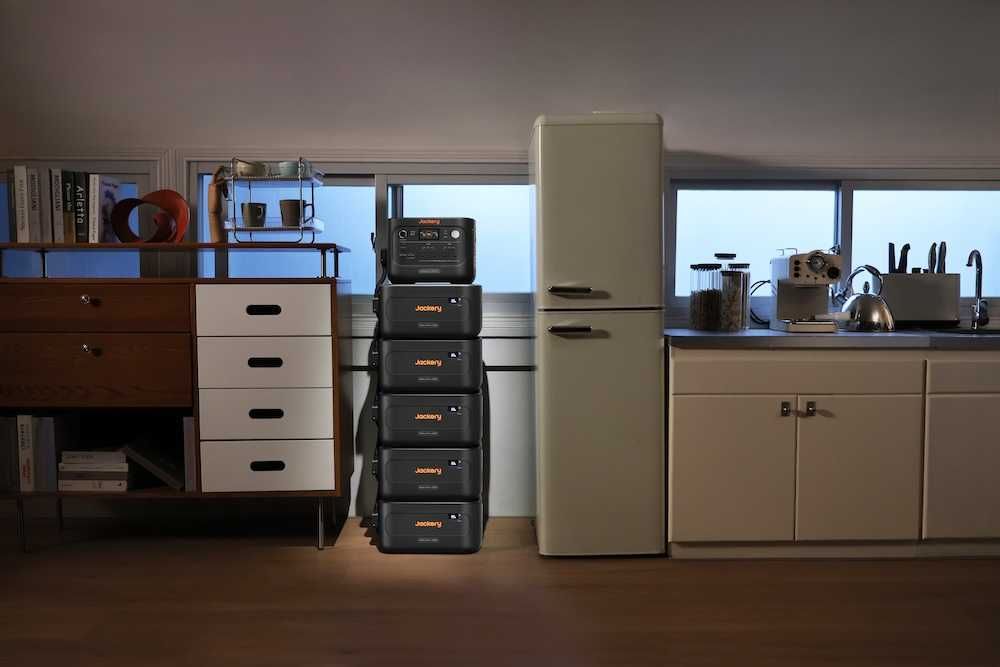
Jackery HomePower 1000 Plus V2: What Buyers Need to Know
Jackery’s new 1,024Wh portable power station combines 1,800W output, expandable storage, fast charging, UPS protection, and app-based energy controls for outages, job sites, RVs, and camping.
Jackery has introduced the HomePower 1000 Plus V2, a portable and expandable power station designed to serve several roles: emergency home backup, mobile power for professional work, and electricity for camping or RV trips. The new system starts with a 1,024Wh battery, supplies up to 1,800W of continuous AC power, and can be expanded to nearly 11kWh with optional Jackery batteries.
That combination places the HomePower 1000 Plus V2 between a conventional portable power station and a larger residential battery system. It can be carried from place to place and does not require permanent installation, but buyers can add storage if the base capacity is not enough.
The HomePower 1000 Plus V2 became available on August 27, 2026, in black and white. It has a $749 suggested retail price, with an introductory price of $619 through September 3. Here is what buyers should understand about its capacity, output, charging options, UPS capabilities, expansion costs, and limitations before purchasing.
What is the Jackery HomePower 1000 Plus V2?

The Jackery HomePower 1000 Plus V2 is a rechargeable battery power station. Unlike a gas generator, it does not produce electricity by burning fuel. Owners charge its internal battery from an AC outlet, compatible solar panels, or a vehicle charging source and then use that stored energy to run connected equipment.
Its 1,024Wh base capacity describes the energy stored in the battery. Its 1,800W continuous output describes how much power it can deliver at one time. These measurements are related, but they are not interchangeable. A device may fall below the power station’s 1,800W output limit yet drain its 1,024Wh battery quickly if it consumes substantial energy for an extended period.
Jackery says the power station can operate roughly 80% of common household appliances and heavy-duty tools. Buyers should still check the running wattage and startup surge of every appliance they plan to connect. The HomePower 1000 Plus V2 supports a surge of up to 3,600W, but that brief surge rating does not mean it can continuously power a 3,600W appliance.
Jackery HomePower 1000 Plus V2 specifications
- Battery capacity: 1,024Wh
- Expandable capacity: Up to approximately 11kWh with optional 2kWh expansion batteries
- Rated AC output: 1,800W
- Surge output: 3,600W
- AC outlets: Four pure sine-wave outlets
- USB-C ports: One 140W Power Delivery port and one 30W port
- USB-A port: One 18W port
- Vehicle-style output: 12V/10A
- UPS transfer time: 10 milliseconds or less
- Surge protection: 3kV/1,000J
- Solar and DC charging input: Up to 400W through dual DC inputs
- Battery chemistry: Lithium iron phosphate, or LiFePO4
- Battery longevity claim: At least 70% capacity after 6,000 cycles
- Dimensions: 12.4 by 7.9 by 9.2 inches
- Weight: 23.8 pounds
- Minimum charging temperature: 14°F (-10°C)
- Warranty: Five years
- Available colors: Black and white
How much can a 1,024Wh power station actually run?
A 1,024Wh rating does not mean that all 1,024Wh will reach connected appliances. Some energy is lost through the inverter and the power station’s electronics. Actual runtime also varies with the appliance, temperature, battery condition, operating mode, and whether other devices are connected.
A useful planning formula is:
Estimated runtime = usable battery capacity ÷ device wattage
For example, a device averaging 100W would theoretically run for about 10 hours from a 1,024Wh battery before accounting for conversion losses. A 500W load would have a theoretical runtime of roughly two hours. Appliances such as refrigerators do not draw their rated power continuously, however, because their compressors cycle on and off.
Jackery estimates that the HomePower 1000 Plus V2 can keep a standard refrigerator operating for up to 19 hours. Buyers should treat that as a scenario-based manufacturer estimate rather than a guaranteed runtime. Refrigerator size, age, room temperature, door openings, compressor cycles, and other connected loads can materially change the result.
This base model is therefore better suited to keeping selected essentials running than backing up an entire house. A refrigerator, modem, router, lights, phones, laptops, television, CPAP machine, or small heating-system component may be practical depending on its electrical requirements. Central air conditioners, electric water heaters, ovens, clothes dryers, and other high-demand appliances will often exceed the system’s output or deplete its battery rapidly.
Expandable storage up to nearly 11kWh

One of this model’s most important features is its modular battery architecture. Owners can begin with the 1,024Wh main unit and add Jackery 2kWh expansion batteries as their needs grow, reaching a stated maximum of approximately 11kWh.
Expansion can be useful for longer outages, multi-day camping, mobile production work, or anyone who needs to run refrigeration and communications equipment overnight. It also lets buyers avoid paying for maximum capacity at the start.
There are important questions to answer before choosing an expanded system. Additional batteries increase the total price, weight, storage space, and recharge time. Buyers should confirm the exact number of supported expansion batteries, compatible battery model, included connection cables, and whether charging performance changes at maximum capacity. They should also compare the complete expanded-system cost with higher-output power stations and installed home batteries.
Capacity expansion does not raise the main unit’s 1,800W continuous output. It increases how long compatible loads can operate, not the maximum combined wattage the system can supply.
Charging speed and solar compatibility
Jackery provides several ways to recharge the HomePower 1000 Plus V2. According to the company, standard AC charging can take the battery from empty to 80% in 36 minutes. AC flash charging can produce a full charge in approximately 50 minutes, while combined AC and DC charging can reduce that estimate to 47 minutes.
Its two DC inputs support up to 400W of solar or DC-to-DC alternator charging. Jackery estimates a full solar charge in as little as two hours and 43 minutes under suitable conditions.
Solar buyers should remember that a panel’s advertised wattage represents performance under ideal laboratory conditions. Clouds, shade, panel angle, temperature, cable loss, and seasonal sunlight affect real-world production. Before connecting a third-party panel, confirm that its open-circuit voltage, operating voltage, current, connector type, and total array configuration fall within Jackery’s published input limits. Matching only the panel’s wattage is not sufficient.
Fast charging is convenient before a storm or trip, but owners should also consider the power required from the wall circuit and whether the fastest charging mode produces additional fan noise or heat. Jackery’s app and operating documentation should identify which charging modes are appropriate for routine use.
How the built-in UPS works
The HomePower 1000 Plus V2 includes an uninterruptible power supply function that Jackery says can transfer connected equipment to battery power within 10 milliseconds when grid power fails or becomes unstable. This is intended to keep equipment such as desktop computers, networking hardware, refrigerators, and other supported devices operating without a disruptive restart.
The unit also includes 3kV/1,000J inline surge protection to help defend connected electronics against power spikes. These features make the product more useful as a continuously connected backup source rather than a battery users retrieve only after an outage begins.
However, buyers should not assume that every sensitive medical device, server, or specialized appliance is compatible simply because the unit has UPS functionality. Check the equipment manufacturer’s power requirements, acceptable transfer time, grounding requirements, and guidance regarding portable power stations. Critical medical equipment should have a backup plan specifically approved by its manufacturer or healthcare provider.
App controls, circuit priorities, and Time-of-Use charging
The companion Jackery app adds energy-management functions beyond basic remote monitoring. Jackery says users can prioritize outputs so less important circuits or loads disconnect as the battery level falls, preserving the remaining energy for critical equipment such as refrigeration.
The system also supports Time-of-Use scheduling. In markets where electricity costs more during peak hours, owners can schedule charging during less expensive periods and use stored battery energy during high-rate windows. Potential savings depend on the utility’s rate structure, the amount of energy shifted, conversion losses, and how frequently the system cycles. Buyers should calculate those factors rather than assuming the feature will quickly recover the purchase price.
App-dependent controls may also require Bluetooth or Wi-Fi connectivity, an account, and current firmware. Core power functions should remain available locally, but buyers interested in automation should review Jackery’s connectivity and privacy requirements.
LiFePO4 battery life and cold-weather operation
Jackery uses lithium iron phosphate battery cells in the HomePower 1000 Plus V2. LiFePO4 chemistry is commonly selected for modern power stations because it offers a long cycle life and good thermal stability. Jackery rates this battery to retain at least 70% of its original capacity after 6,000 full charge cycles, which it equates to approximately 16 years of daily cycling.
That does not mean the battery will remain at its original capacity for 16 years or that every component is guaranteed for that period. Cycle-life estimates depend on charging patterns, depth of discharge, storage conditions, temperature, and power demand. The product’s warranty lasts five years.
Jackery says its Cell-to-Body construction integrates the cells into the chassis to create a more compact and durable design. The power station measures 12.4 by 7.9 by 9.2 inches and weighs 23.8 pounds. That is portable enough for many adults to carry, although “one-handed portability” will depend on the user and carrying distance.
The battery can charge at temperatures as low as 14°F (-10°C), according to Jackery. Cold-weather buyers should distinguish between charging and discharging temperature ranges and verify both in the manual. Lithium batteries typically require specific protections when charging below freezing.
Where the HomePower 1000 Plus V2 fits best
The HomePower 1000 Plus V2 could be a good fit for:
- Households seeking backup power for selected essentials during short outages
- Apartment and condominium residents who cannot operate a gas generator
- Remote workers who need to protect computers and internet equipment
- Photographers and video crews powering lights, cameras, laptops, and charging gear
- Contractors using compatible tools at locations without convenient outlets
- Campers and RV travelers who want quiet, emissions-free power at the point of use
- Existing Jackery customers who value modular battery expansion
It may be less suitable for buyers expecting automatic whole-home backup, permanent electrical-panel integration, very high 240V loads, or indefinite off-grid operation. Nothing in Jackery’s announcement indicates that this model supplies 240V power or directly connects to a home electrical panel. Buyers should not backfeed a home circuit through an outlet. Any transfer equipment or household wiring work should be handled with approved hardware and a qualified electrician.
What to check before buying
Before ordering, make a list of every device you want to run and record its continuous wattage, startup surge, and expected daily operating time. Add the simultaneous loads to ensure they remain below 1,800W, then estimate the watt-hours required for the desired backup period.
Buyers should also verify:
- Whether 1,024Wh is sufficient or expansion batteries will be necessary
- The exact expansion-battery model, quantity limit, price, and cable requirements
- AC and DC input limits for intended solar panels or vehicle chargers
- Runtime requirements for refrigerators, heating equipment, medical devices, or computers
- Whether the four AC outlets can physically accommodate large power adapters
- App connectivity, account, firmware, and network requirements
- Operating, charging, and storage temperature ranges
- What the five-year warranty covers and how warranty service is handled
- Whether the introductory price includes any solar panel or expansion battery
Price and availability
The Jackery HomePower 1000 Plus V2 is available in black and white through Jackery and Amazon. Its MSRP is $749. Jackery is offering an early-bird price of $619 from August 27 through September 3, 2026. The base purchase includes Jackery’s five-year manufacturer warranty; buyers should confirm package contents before ordering because solar panels and expansion batteries may be sold separately.
GearBrain’s take
On paper, the Jackery HomePower 1000 Plus V2 offers a strong balance of portability, power, and future expansion. The 1,800W pure sine-wave output should cover many common appliances and tools, while the 10-millisecond UPS, fast AC charging, app-based load priorities, and Time-of-Use scheduling make it more versatile than a basic camping battery.
The key limitation is that its initial 1,024Wh capacity is designed for selected loads, not unrestricted whole-home backup. Its nearly 11kWh expansion ceiling is appealing, but buyers should price the full configuration and remember that added battery capacity does not increase the 1,800W output ceiling.
For someone who wants a compact backup system today and the option to add runtime later, the HomePower 1000 Plus V2 appears well positioned. The best buying decision will come from calculating actual appliance loads, confirming charging compatibility, and choosing enough storage for the intended outage, work, or camping scenario.
GearBrain has not yet conducted hands-on testing of the Jackery HomePower 1000 Plus V2. Product specifications, charging times, runtime estimates, cycle-life figures, and performance claims in this article are based on information supplied by Jackery. Real-world results may vary.
