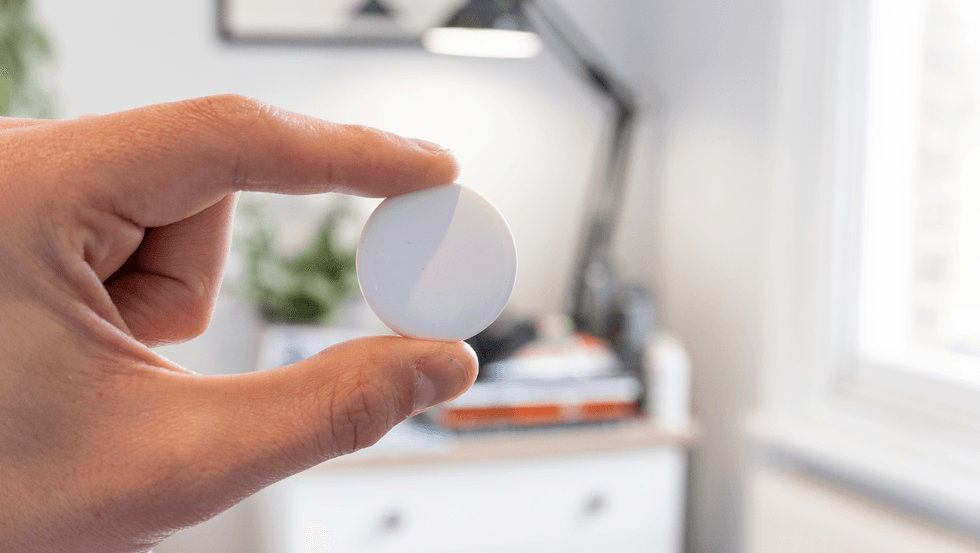
AirTag vs GPS Tracker: Which Offers Better ROI for Business
For most businesses, a dedicated GPS tracker returns more value than an AirTag. An AirTag is cheaper, but it only reports a location when an Apple device passes nearby, and it warns whoever carries it that it is there.
A GPS tracker costs more and usually adds a connectivity fee. In return, it reports on a schedule you set, works far from people, runs for years on one battery, and feeds data into fleet, ERP, or warehouse systems. AirTags make sense only for small, low-value items kept close to iPhone users.
The reasons matter more than the verdict, because the AirTag vs GPS tracker choice is rarely about the device itself. It is about what a missing asset costs you.
Why does a €35 AirTag look like the smarter buy?
Apple's new AirTag sells for €35 in Germany, or €119 for a four-pack. A professional GPS tracker costs several times that before you pay for any data plan. On a purchase order, that gap looks like the end of the discussion. On a balance sheet, it often points the other way.
How should a business measure tracking ROI?
Tracking ROI is the money a device saves you minus what it costs to run. The savings usually come from four places:
- Avoided losses. Equipment that isn't stolen or is found quickly when it disappears.
- Search time. Hours your team no longer spends walking yards, calling sites, or checking spreadsheets.
- Fewer duplicate purchases. Assets you do not buy twice because nobody could find the first one.
- Better utilization. Clear data on which trailers, containers, or machines sit idle.
Subtract hardware, connectivity, battery changes, and admin time, and you get the real number. Seen like this, the GPS tracker vs AirTag debate moves from "which one is cheaper" to "which one actually produces those savings."
What is the real difference between an AirTag and a GPS tracker?

Both devices answer the question "where is it?", but they get there in completely different ways.
How does an AirTag find its location?
An AirTag has no satellite receiver. It sends a Bluetooth signal that any passing iPhone, iPad, or Mac in Apple's Find My network picks up and reports, together with its own position. The location you see is really where the last Apple device came close.
On a rural building site, inside a steel container or at an empty depot at night, hours can pass without a single report. That is why the search term "gps airtag" is misleading: the tag borrows positions from strangers' phones instead of calculating its own. Ultra Wideband adds a pointing arrow, but only within a few dozen meters.
How does a GPS tracker find its location?
A GPS tracker calculates its own position from satellite signals (GNSS) and sends it over a cellular network such as LTE-M or NB-IoT, or over LoRaWAN. It does not need anyone to walk past. Business-grade devices usually add:
- Scheduled reporting. Frequent updates while the asset moves, fewer while it is parked.
- Geofences. An alert when an asset enters or leaves a defined site.
- Motion and tamper alerts. Alerts when something moves after hours or the device is disturbed.
To see what the AirTag vs GPS tracker difference means for trailers, containers, and tools in daily operations, the SmartMakers product overview explains how satellite tracking works without site infrastructure.
AirTag vs GPS tracker: why unit price is not the same as ROI

Price per device is the easiest number to compare, and on its own it is the least useful one.
What does an AirTag really cost a business?
The hardware is cheap, but everything around it was built for consumers. Apple's January 2026 launch of the second-generation AirTag brought a louder speaker, a longer finding range, and cross-platform alerts against unwanted tracking. Anyone hoping for a true GPS AirTag will not find it here, since the new model still has no satellite receiver. For a business, that leaves several hidden costs:
- Theft alerts work against you. Apple alerts iPhone and Android users when an unknown AirTag travels with them, thieves included. Removing the tag takes seconds.
- One personal account per tag. Each tag sits in an individual Apple Account with limited sharing, so managing hundreds of them becomes a spreadsheet exercise.
- No link to business systems. Find My cannot push locations into ERP, WMS or fleet software, so someone checks an app by hand.
- Apple devices only. Setup needs an iPhone or iPad running iOS or iPadOS 26 or later.
- Yearly battery swaps. The coin cell lasts about a year, so you need regular trips to every asset.
What does a GPS tracker really cost a business?
Expect a higher unit price, a recurring connectivity and software fee, and some setup work. In exchange, you get scheduled, silent reporting, central management, and data that flows into your existing systems. Over several years, fewer battery changes and less manual checking close much of the price gap.
Factor | AirTag (2nd generation) | Business GPS tracker |
How position is found | Bluetooth relay via nearby Apple devices, UWB at close range | Satellite positioning (GNSS), sent via cellular or LoRaWAN |
Where it works | Only where Apple devices pass by | Wherever satellite and network coverage reach |
Update timing | Unpredictable | Scheduled by you, or triggered by movement |
When stolen | Alerts the person carrying it | Stays silent, can alert you instead |
Battery | Replaceable coin cell, about 1 year | Depends on device; some low-power models run 10–15 years |
Management | Personal Apple Account | Central platform with roles and API |
Business integration | None | ERP, WMS, fleet software |
Purchase price | €35 single, €119 four-pack (Germany) | Higher, plus connectivity fee |
When does the GPS tracker vs AirTag decision tip one way or the other?

The answer depends less on the device and more on the asset's value, where it goes, and who needs to see it.
When is an AirTag enough?
A consumer tag can be a sensible, low-cost choice in a few narrow cases:
- Cheap items such as spare keys or bags, where replacement costs less than proper tracking.
- Items that mostly stay in an office or travel with an employee who uses an iPhone.
- A short test with a few tags to check how often items really go missing.
When does a GPS tracker pay for itself?
The balance shifts quickly once assets leave your premises or carry real value. The BauWatch Crime Report 2025, based on a survey of about 3,900 construction professionals across Europe, found that two in three UK respondents had seen site crime rise over the previous 12 months. The same study links 37% of theft incidents to project delays of three to four weeks, so the delay often costs more than the stolen item. GPS trackers pay off fastest for:
- Trailers, swap bodies, containers, and load carriers that spend weeks at customer sites or on the road.
- Generators, compressors, attachments, and other unpowered equipment parked overnight on remote job sites.
- Assets shared across several locations or partners, where different teams need the same live view.
- Any process where location data should automatically land in ERP or WMS, without anyone scanning or calling.
How does SmartMakers approach GPS asset tracking?
Berg Insight's Global Construction Equipment OEM Telematics Market report (December 2025) counted 7.8 million active OEM telematics units worldwide at the end of 2024 and expects 13.4 million by 2029. New machines increasingly ship with built-in tracking, so the real gap is trailers, containers, attachments, and load carriers with no engine or power supply. SmartMakers GPS Asset Tracking is built for exactly these assets:
- Long runtime. Edge localization calculates position on the device, allowing 10 to 15 years of battery life.
- Meter-level accuracy. AI-enhanced positioning sharpens each location fix.
- No site infrastructure. Trackers work across sites, countries, and partner locations.
- System integration. Positions, movement history, and operating hours flow into ERP, WMS, or a team's smartphone.
The Real Time Operations Suite is designed for daily use within about six weeks.
Which one offers better ROI for business?
A tracker only pays off if it reports when it matters, and an AirTag reports when someone else's phone happens to be nearby. That single fact settles most of the question for business use. For trailers, containers, unpowered equipment, and anything that leaves your site, a GPS tracker costs more up front but pays for itself through fewer losses, less searching, and usable data.
SmartMakers combines long-life GPS hardware with a platform that feeds location data into the tools your teams already work in.
See where your mobile assets really are, across every site, without anyone scanning or calling. Book a 30-minute demo with SmartMakers.
FAQ
Can an AirTag be used as a GPS tracker?
Not really. There is no such thing as a GPS AirTag, because the device has no satellite receiver. It relies on nearby Apple devices to report its position over Bluetooth, so updates depend entirely on who passes by.
Does an AirTag work if no iPhone is nearby?
It keeps broadcasting its Bluetooth signal, but no one receives it. Its location on the map stays frozen at the last point where an Apple device detected it. In remote yards or metal containers, that gap can last hours.
Is an AirTag a good way to track a company vehicle or trailer?
It gives a rough idea in busy areas but is a weak choice for fleets. Anyone traveling with the vehicle may notice the tag, and the data cannot reach fleet or ERP software. A GPS tracker gives scheduled positions, geofence alerts, and a central view for the whole team.
Do GPS trackers need a monthly subscription?
Most business GPS trackers require a monthly subscription because they send data over cellular or LoRaWAN networks and use a software platform to display it. The fee covers connectivity, data storage, and features such as alerts, reports, and integrations.
Which is better for theft recovery, a GPS tracker vs. AirTag?
A GPS tracker, in nearly every business case. It reports silently and can alert you when an asset moves after hours or leaves a set area. An AirTag notifies the person carrying it and reports only when Apple devices are nearby, which gives a thief time and a reason to remove it.
