Mobile World Congress began on March 2, 2026, in Barcelona at Fira Gran Via, running through March 5. The event opened its doors with the show’s organizers emphasizing priorities around 5G progression, AI, and digital safety—framing the industry conversation that many exhibitor announcements are now echoing.
In this article, I will summarize the opening-day announcements we found noteworthy. I will also help you learn when these new technologies will be launched and what they mean for consumers.
Consumer devices and everyday tech unveiled at the show
 MWC 2026 EntranceMWC
The opening-day device news clustered around “AI for daily life”: language translation, eye-comfort screens, camera accessories for creators, rugged mobility, and pocket-sized entertainment—often paired with words like “ecosystem,” “agentic,” and “human-centric.”
 Timekettle W4 Pro AI Interpreter Earbuds,Bidirection Simultaneous Translation,Translator Device Supporting 40 Languages,Translator Earbuds for Call and Video Translation,APP Work with iOS and Android timekettle
Timekettle — W4 AI interpreter earbuds
What it is: AI translation earbuds positioned for real-world, noisy environments. What was announced today: the company’s MWC debut and its spotlight on the W4 as an “upgraded” system built on “Babel OS 2.0,” combining “AI Bone‑Conduction Pickup” (capturing voice vibrations rather than relying only on air microphones) with a “SOTA Engine Selector” that chooses translation engines by language pair and context. Why it matters: If the core promise holds (clear capture + context-fit translation), this category moves beyond novelty and toward dependable business/travel use—an important shift as multilingual collaboration becomes routine at global events like MWC.
 TCL — NXTPAPER 70 Pro smartphone focused on eye comfort TCL
TCL — NXTPAPER 70 Pro smartphone focused on eye comfort
What it is: A smartphone built around “NXTPAPER 4.0,” described as a combined hardware-and-software eye-comfort approach. What was announced today: (1) a dedicated “NXTPAPER Key” to switch display modes; (2) an eye-care feature set (anti-glare and reflection reduction, blue light claims, flicker-free/DC dimming, and low brightness capability); and (3) mainstream “daily phone” specs and pricing/availability positioning, including a 50MP OIS main camera, IP68 rating, and two stated EU RRPs (€299 / €359 depending on storage) with availability spanning multiple regions. Why it matters: TCL is pushing “eye comfort” as a primary smartphone differentiator—useful for heavy readers, students, and hybrid workers—and it’s packaging it with AI tools (translation and reading/writing helpers) to keep the device positioned as modern, not niche.
TCL — CrystalClip open‑ear earbuds
What it is: Open‑ear, clip-on earbuds designed to preserve environmental awareness while listening. What was announced today: TCL frames CrystalClip as an “air conduction” approach; it highlights comfort/fit metrics (including a clamping-force claim), lightweight design (5.5g per earbud), and IPX4 water resistance, alongside “AI‑powered” functionality language and an all‑day use narrative. Why it matters: Open‑ear audio continues to expand beyond sports into office and commuting scenarios, and MWC positioning suggests brands see this as an ecosystem companion category (especially when paired with phone features like translation and voice tools).
TCL — New tablet lineup
What it is: A broader tablet portfolio aimed at productivity and entertainment. What was announced today: TCL introduces a range led (in the release excerpt) by the Note A1 NXTPAPER e‑note concept (paired with a stylus that is positioned for handwriting realism) and the TAB A1 Plus (a 12.2-inch 2.4K, 120Hz class entertainment tablet), plus built-in AI assistant language and discovery tools. Why it matters: This is TCL reinforcing that NXTPAPER is not a single product but a platform strategy spanning device types—important for SEO and shopping guidance, where buyers often compare tablets by use case (notes/reading vs. streaming/work).
TCL — NXTPAPER expands to AMOLED displays
What it is: A display-technology announcement rather than a single device. What was announced today: TCL states that NXTPAPER will be integrated with AMOLED “for the first time,” positioning this as a step toward combining eye comfort with flagship‑class display traits (for example, high brightness and color accuracy claims in the same release). Why it matters: If NXTPAPER-on-AMOLED becomes real products at scale, it could pressure competitors to treat eye comfort (anti-glare, low visual fatigue) as a premium feature rather than a budget compromise.
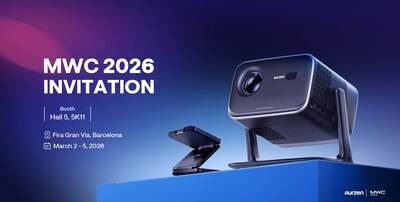
 Aurzen — pocket-sized projection and “audio projector” lineupAuurzen
Aurzen — pocket-sized projection and “audio projector” lineup
What it is: Portable projectors and audio-forward projector models. What was announced today: Aurzen uses MWC to highlight the ZIP series (including foldable designs intended for ceiling or angled projection, marketed for “no Wi‑Fi needed” viewing) and BOOM mini/BOOM air models that it says include Google TV support, plus accessory ecosystem details (casting dongle, multi-angle mounts, and a stand with a 10,000mAh battery). The company also ties the announcement to limited-time regional promotions starting March 2 (CET). Why it matters: MWC is historically device-and-network heavy; Aurzen’s presence signals portable entertainment is now part of “mobile life” narratives at connectivity shows, especially as people expect large-screen experiences without dedicated living-room setups.
Blackview — rugged ecosystem showcase plus AI smart glasses
What it is: Rugged phones/tablets plus wearables and companion devices. What was announced today: Blackview’s MWC messaging centers on an “AI × Communication × Rugged” ecosystem, calling out new rugged flagship concepts (including thermal imaging in a “Pro” variant and a satellite-connected model) and the BV100 AI smart glasses with an 8MP camera and voice assistant positioning. It also publishes a clear on-site call to action (booth 7G40). Why it matters: Rugged devices used to be a specialist corner; this framing suggests rugged brands want to compete in mainstream “AI wearable ecosystem” conversations—especially where satellite connectivity and field-work features overlap with safety and resilience themes at MWC.
vivo — X300 Ultra “first look,” 400mm equivalent telephoto extender, and global availability
What it is: A flagship imaging phone plus a pro photography kit concept. What was announced today: vivo showcased design and a “professional photography kit” built around a 400mm equivalent “vivo ZEISS Telephoto Extender Gen 2 Ultra,” plus a camera cage accessory with physical controls, mounts, and active cooling language. Importantly, vivo also states it plans to launch the X300 Ultra in global markets later this year. Why it matters: MWC has been re-tilting toward premium imaging, creator tools, and accessories; vivo is turning that into an ecosystem play (phone + optics + rig) rather than a single spec race.
HONOR — AI vision roadmap featuring Robot Phone and Magic V6
What it is: A platform narrative plus flagship hardware teasers. What was announced today: HONOR frames its announcements under an “Augmented Human Intelligence” vision and an “ALPHA PLAN” with three pillars, while previewing a conceptual “Robot Phone” tied to embodied intelligence and spatial/motion ideas. It also introduces the Magic V6 foldable as a flagship, plus related ecosystem devices, and highlights next-gen silicon-carbon battery direction in its on-site messaging. Why it matters: This aligns with a broader MWC theme: “AI devices” are expanding from apps into hardware forms (robots, foldables, wearables), and brands are competing on who can define the new category vocabulary first.
TECNO — expanded AI ecosystem anchored by new phone lines and luxury collaboration
What it is: Smartphones and connected AIoT products for a broader device ecosystem. What was announced today: TECNO highlights the CAMON 50 Series and POVA 8 Series, plus a partnership with Tonino Lamborghini, along with laptops, tablets, wearables, and “Ella” voice assistant positioning in the release. Why it matters: TECNO’s “practical AI” positioning is geared to high-volume markets; at MWC it’s leveraging the show to present AI as an integrated experience across price tiers and product categories, not just a flagship feature.
Networks, cloud, and “AI-native” telecom infrastructure
 Networks, cloud, and “AI-native” telecom infrastructure pixabay
If Day One had a single infrastructure keyword, it was “AI-native”—applied to telecom operations, telco cloud, RAN architectures, and open tooling for telco-grade AI.
SK Telecom — “AI Native” strategy (operator operations + national AI infrastructure)
What it is: A telecom-to-AI infrastructure repositioning. What was announced today: SKT describes an “AI Native” transformation that embeds AI into core telco systems and network operations (including autonomous operations and AI-RAN ambitions), alongside a major build-out plan for “1GW-class” hyperscale AI data center capacity across Korea and a sovereign model roadmap from 519B parameters to over 1T parameters (including multimodal capability plans in the second half of 2026). The release also references collaboration on an AI data center in Korea’s southwestern region with OpenAI. Why it matters: This is a clear example of telcos claiming a new role: not just providing connectivity, but becoming AI infrastructure providers—competing on compute, orchestration, and AI operations competency.
Huawei — telco cloud pivot from cloud-native to AI-native (TICC)
What it is: A telco cloud infrastructure positioning shift. What was announced today: Huawei argues telco clouds are transitioning from cloud foundations to AI infrastructure, and introduces its “Telco Intelligent Converged Cloud (TICC)” as a hyper-converged architecture that unifies management and scheduling across compute, storage, network, and AI compute resources. The release frames operator challenges as compute cost-efficiency, AI integration across multi-generation networks, and rapid scaling into service scenarios. Why it matters: This aligns with operator narratives about consolidating AI workloads and network functions into shared platforms—an architectural choice that influences capex, energy, and vendor strategy for years.
SoftBank Corp. — Telco AI Cloud vision
What it is: A blueprint for distributed AI infrastructure embedded in telecom networks. What was announced today: SoftBank’s “Telco AI Cloud” concept combines GPU cloud for training, AI-RAN-based MEC for low-latency inference, and an “Infrinia AI Cloud OS” stack to manage it end-to-end; it also describes an “AITRAS Orchestrator” that dynamically allocates resources between RAN control and AI processing. Why it matters: This is one of the more explicit statements that telecom networks will function as “the placement layer” for AI inference (edge) while data centers do training—potentially reshaping how latency-critical AI services are deployed for robotics, industrial systems, and consumer services.
GSMA — Open Telco AI initiative for telco-grade models
What it is: An industry initiative intended to raise AI model performance on telecom-specific tasks via open collaboration. What was announced today: Open Telco AI is presented as a portal and community framework for models, datasets, compute access, and benchmarks, with progress measured through a “Telco Capability Index.” The launch specifically calls out contributions including a family of open telco models from AT&T and compute support from AMD and TensorWave. Why it matters: Telecom networks are safety-critical and highly regulated; by emphasizing benchmarks and “telco-grade” reliability, GSMA is pushing the industry toward shared evaluation standards rather than one-off demos.
MSI — scalable AI-vRAN / AI-RAN platform built with NVIDIA AI Aerial
What it is: Server and platform architecture for AI-enabled virtual RAN deployments. What was announced today: MSI says it is showcasing an AI-vRAN stack at MWC (booth 5A61) with dynamic GPU allocation so infrastructure can be flexibly assigned between 5G communications and AI workloads, and it highlights specific platform SKUs designed for dense GPU or edge-friendly deployments. Why it matters: The message is that RAN workloads and AI inference may increasingly share the same accelerated compute footprint—an approach consistent with NVIDIA’s own “software-defined AI-RAN” positioning for 5G/6G.
UfiSpace — AI-optimized 1.6T open networking portfolio
What it is: High-bandwidth switching and secure aggregation designed for AI clusters and AI data center interconnect. What was announced today: UfiSpace launched a 1.6T “AI-optimized” portfolio featuring an AI fabric switch and a secure aggregation platform with line-rate MACsec/IPsec, and it ties the roadmap to thermal and power constraints (including liquid-cooling demonstrations planned for OFC 2026). Why it matters: As GPU clusters scale, the “AI factory” story becomes impossible without parallel scaling in switching throughput, power efficiency, and encryption for distributed AI infrastructures.
Mycom and Mavenir — agentic AI collaboration for autonomous networks L4/L5
What it is: A partnership aiming to operationalize multi-agent AI in live network assurance. What was announced today: The release describes agent-to-agent (A2A) integration between Mycom’s “GenAie NOC Copilot” and Mavenir’s intent and network-function agents, framed as accelerating closed-loop detection, diagnosis, and remediation while targeting TM Forum Autonomous Network Levels 4 and 5. Why it matters: This is part of a broader MWC push to move from “AI assistants” to “agentic” systems that can execute corrective actions—where governance, safety, and auditability become as important as model accuracy.
Pegatron 5G and Metanoia — ORAN base station collaboration using SoC platforms
What it is: Development of next-gen ORAN base stations (including mid-power and small-cell categories). What was announced today: The partnership emphasizes energy efficiency vs. FPGA-based approaches and cites feature support such as daisy-chain and cell aggregation, plus references Pegatron’s broader ORAN portfolio and booth presence (Hall 5/5E12). Why it matters: This is the hardware-layer counterpart to AI-native network software: open RAN economics still hinge on efficient silicon, faster time-to-market, and workable integration paths for diverse operators.
Lifecycle Software — NEXUS IQ, “telco-native AI” for customer value management
What it is: A product positioned to turn event data into personalized “revenue journeys.” What was announced today: Lifecycle says NEXUS IQ unifies data sources, forecasts acquisition/upsell/churn propensity, and includes a campaign manager for automated personalization, with stated outcome claims like churn reduction and customer lifetime value impact. Why it matters: Not all “telco AI” is about RAN or the core; this is about monetization and retention, and it fits the show-wide theme that AI will be deployed across billing, marketing, and customer lifecycle operations.
Ekinops and O2 Telefónica — fixed-mobile B2B connectivity extension
What it is: A co-developed solution positioned to bring 5G speed and resilience to enterprise sites that are hard to serve with fixed access alone. What was announced today: The release frames the product as a 5G “mobile fixed line extension” that can reach deep indoor areas and support faster deployment for complex installations, targeting businesses where downtime is unacceptable. Why it matters: This is a practical enterprise connectivity story—how operators package 5G as a service continuity layer when fiber or fixed broadband is slow or infeasible.
Security and trust: AI factories, roaming protection, and in-home visibility
A second dominant Day One theme was: scaling AI and connectivity expands the attack surface—so security has to be designed into the infrastructure layer (AI factories), the interconnect layer (roaming), and the home experience layer (visibility past the demarcation point).
Palo Alto Networks — “Secure by Design AI Factories” ecosystem
What it is: A security ecosystem announcement tied to “AI factory” deployments and sovereign AI language. What was announced today: Palo Alto Networks describes four collaborations (including with Nokia, U Mobile, Aeris, and Celerway) intended to secure AI factory infrastructure and the “autonomous edge,” emphasizing integrating security services from the data center into 5G and IoT networks. Why it matters: As NVIDIA defines an “AI factory” as end-to-end infrastructure for the full AI lifecycle, securing that lifecycle becomes a foundational requirement, not an add-on—especially for sovereign/regional deployments.
BroadForward and e& — secure 5G roaming via SEPP
What it is: An operator deployment of a Security Edge Protection Proxy (SEPP) to secure 5G roaming and interconnect signaling. What was announced today: e& UAE says it selected BroadForward’s SEPP to strengthen 5G and international roaming security, with implementation support referenced through Emircom and with emphasis on interoperability and 4G–5G interworking. Why it matters: According to 3GPP, SEPP is a defined element of the 5G roaming security architecture at the operator perimeter, enabling secured inter-PLMN communication via the N32 interface—this is the standards-aligned pathway operators are expected to use as 5G roaming scales.
TechSee — Visual AI platform for whole-home network visibility
What it is: An end-to-end “home experience” platform designed to extend service provider visibility beyond the modem/router boundary. What was announced today: TechSee positions its platform as unifying sales, onboarding, support, and renewals via “Whole‑Home Connectivity Assurance,” promoting room-level insights and visual diagnostics and publishing outcome claims (reduced repeat contacts and truck rolls in early deployments). Why it matters: As smart home device counts rise, connectivity problems increasingly happen in-room and device-to-device; operators that can see and diagnose those issues earlier can reduce churn and support costs—making “in-home visibility” a competitive differentiator for broadband and telco providers.
Durin with Qualcomm Technologies — hands-free residential access demo using edge AI + UWB
What it is: A live MWC demonstration of multimodal access control (face recognition + UWB proximity) computed at the network edge. What was announced today: Durin describes a demo where facial recognition runs on local hardware at the edge (router), while UWB in a smartphone confirms precise proximity; unlock occurs only when both signals match, framed as “privacy-first” with no cloud processing. Why it matters: This connects two Day One themes—UWB spatial certainty and edge AI—and suggests future access control may be evaluated not only on convenience but on local processing, privacy, and spoofing resistance.
Chips, radio, and industrial connectivity: UWB, satcom, cellular IoT, and smart factories
Beyond phones and networks, Day One’s releases also show the “connected intelligence” story depends on radio innovations (UWB, satcom, NTN), efficient cellular IoT roadmaps, and industrial network modernization for AI-enabled manufacturing.
Eforthink — UWB “spatial perception” for Industry 4.0 and smart living
What it is: UWB-based precision positioning and spatial interaction concepts across industrial RTLS and consumer smart ecosystems. What was announced today: Eforthink’s press release highlights a multi-modal fusion stack combining UWB/GNSS/Bluetooth for “end-to-end location services,” makes sub‑10cm accuracy claims for industrial tracking plus 3D visualization and interference resilience, and introduces consumer “Eforlink” concepts (ScreenLock, identity presence sensor, pet tag) framed around distance-triggered automation rather than app/voice lag. Why it matters: UWB ranging is often based on time-of-flight measurements; FiRa emphasizes ToF as the operating concept for UWB “ranging” between devices, and UWB’s precision enables proximity interactions that are hard to replicate with Bluetooth alone—making this a plausible foundation for both industrial safety and consumer access/automation experiences.
Nordic Semiconductor — major cellular IoT portfolio expansion (Cat 1 bis, NTN, edge AI, and 5G eRedCap path)
What it is: New chip/module families and roadmap updates for long-life, low-power IoT connectivity. What was announced today: Nordic announces the new nRF92 and nRF93 series (including satellite NTN positioning and Cat 1 bis positioning), updates to the nRF91 series including NTN compliance claims for the nRF9151, and references sampling/availability windows (for example, nRF93M1 mid-2026 availability claims and nRF92 GA language tied to 2027). Why it matters: This is a direct response to two macro-shifts: more IoT devices need global coverage (including non-terrestrial) and more devices want local edge intelligence without giving up multi-year battery life.
Sivers Semiconductors — SATCOM and fixed wireless beamforming showcase
What it is: Ka-band antenna arrays and beamforming chipsets intended for electronically steered satcom ground terminals. What was announced today: Sivers announces MWC participation and a live demo of a “Maverick” Ka-band 576-element transmit antenna array integrating its “Cloudchaser” chipset, with customer sampling availability stated in the release. Why it matters: As operators and vendors talk about resilient connectivity and NTN convergence, ground-terminal beamforming becomes a practical enabler—especially as satcom moves toward more consumer-adjacent form factors and enterprise backhaul needs.
GSMA Foundry and European Space Agency — up to €100M funding access for AI/NTN/D2D/6G
What it is: A funding initiative intended to scale space–mobile convergence projects. What was announced today: GSMA says ESA-backed funding “worth up to €100M” will target AI for multi-orbit/terrestrial orchestration (AI x NTN), standards-based direct-to-device pilots, 5G/6G hubs/testbeds, and early 6G innovation areas where satellite–terrestrial convergence matters. Why it matters: This is the strongest “space meets mobile” signal in the Day One list: it explicitly funds the bridge between terrestrial mobile networks and satellite assets, framing hybrid connectivity as commercial, not experimental.
Huawei Cloud — hybrid cloud foundation (HCF) and summit releases
What it is: A hybrid cloud platform positioned for enterprise AI-era complexity. What was announced today: Huawei Cloud uses its summit to launch “Huawei Cloud Foundation (HCF)” globally as a hybrid cloud offering described as “open,” “simplified,” and “resilient,” including claims about decoupled architecture for hardware reuse and standardized integration. The summit release also references an “Industry AI Foundry” direction and “CodeArts” as an AI-powered coding agent, with availability timing described for the second half of 2026. Why it matters: This reflects a pragmatic enterprise reality: many organizations are staying hybrid for governance and compliance, but want modern AI tooling—so hybrid cloud offerings are now competing on how quickly they can enable AI adoption without locking customers into single-vendor stacks.
Huawei — industrial networks report and smart factory architecture direction
What it is: An industrial networking report and a smart factory solution narrative presented during the manufacturing forum at the show. What was announced today: Huawei’s release introduces the “Fully Connected Industrial Networks” report and outlines major trend categories (ubiquitous access, converged connectivity, autonomous networks, integrated security), then maps that to its smart factory solution pillars (IT/OT convergence, wireless deployment, and integrated security/O&M). Why it matters: AI in manufacturing is often limited by data quality and network determinism; this release argues the network layer must be modernized to support AI integration, aligning factory connectivity upgrades with broader “autonomous network” language across MWC.
Key takeaways shaping the opening day narrative
 industrial networks report and smart factory architecture direction Photo by Point3D Commercial Imaging Ltd. on Unsplash
Across the full list of announcements, several patterns stand out for “Day One at MWC 2026”:
First, “AI-native” is being claimed at every layer: in operator strategy (SK Telecom), telco cloud infrastructure (Huawei), edge + RAN computing (SoftBank, MSI), and industry benchmarking (GSMA Open Telco AI). This suggests a shift from “AI features” toward “AI operating models” and “AI infrastructure,” where the competitive advantage is orchestration and reliability, not just model access.
Second, device makers are leaning into “human factors” as differentiators—eye comfort (TCL), language access (Timekettle), creator tooling (vivo), and situational awareness (open‑ear audio; rugged + satellite; embodied intelligence concepts). That’s not cosmetic: it aligns with how people actually search (“eye-friendly phone,” “real-time translation earbuds,” “portable projector,” “400mm telephoto phone”).
Third, security is being pulled “left” into architecture. Palo Alto Networks’ “secure by design AI factories” framing and BroadForward/e&’s SEPP deployment both emphasize that sensitive AI and 5G interconnects cannot be protected upside-down (after deployment); the security function needs to sit at the perimeter and in the platform foundations.
Fourth, the “space + mobile” convergence is materially funded and productized (ESA/GSMA Foundry funding access; Nordic’s NTN roadmap; Sivers’ satcom arrays). Rather than a futuristic sidebar, NTN is being treated as an architectural pillar for resilience, coverage, and new service classes.
Finally, the workforce is being explicitly tied to the AI transition. ManpowerGroup (with Experis) frames “AI model/app development” and “AI literacy” as top hardest-to-fill skills in its cited survey results and uses MWC programming (Talent Arena meetups and workshops) to position workforce intelligence as a core part of AI adoption. This reinforces the idea that many MWC 2026 announcements are not just about tech availability, but about execution capacity—skills, operations, and governance.
Be on the lookout for more coverage from MWC 2026 and our Editoer's Choice Award winners as Best of Show later this week.
From Your Site Articles
Related Articles Around the Web
 MWC 2026 EntranceMWC
 Timekettle W4 Pro AI Interpreter Earbuds,Bidirection Simultaneous Translation,Translator Device Supporting 40 Languages,Translator Earbuds for Call and Video Translation,APP Work with iOS and Android timekettle
  TCL — NXTPAPER 70 Pro smartphone focused on eye comfort TCL
  Aurzen — pocket-sized projection and “audio projector” lineupAuurzen
 Networks, cloud, and “AI-native” telecom infrastructure pixabay