
The Conversation (0)
How Salesforce Integrations Enhance LMS Learning Programs
How integrating Salesforce with LMS platforms drives personalized learning, improves performance tracking, and boosts employee engagement across organizations
Organizations continuously seek ways to maximize employee value and foster their development. Salesforce offers numerous tangible benefits by integrating with learning management systems (LMS). The collaboration allows companies to seamlessly integrate sales and learning data, nurture personalized development, and measure sales growth at scale. Together, they can help organizations take their training programs to the next level and help employees more efficiently by providing targeted learning opportunities that align with sales goals and performance metrics.
Salesforce LMS integrations enable customization of learning paths for each employee. Salesforce records the progress of sales representatives as they interact with clients and achieve milestones. As sales representatives interact with clients and achieve milestones, their progress gets recorded in Salesforce. The LMS can then assign specific modules or courses based on this data. Personalized content keeps employees motivated, engaged, and focused on areas where improvement will have the greatest impact.
Integrating Salesforce with an LMS creates a single window for employee and sales performance. Such a combination enables the organizations to zero in on the skill gaps and training requirements. Sales performance data aligned with learning metrics allows managers to easily identify who needs more training. Such an approach allows for differentiated instruction to address individual and team needs.
Time-consuming and costly, manual data entry often leads to errors. Integrating Salesforce with a Learning Management System (LMS) automates several administrative tasks, including updating records and assigning courses based on the programs the employee is enrolled in. Staff can actually spend time on work that matters rather than keyboard bashing. Reminders and reports are also automated, keeping learners on track without managers constantly supervising progress.
A unified system improves communication between management and their teams. Salesforce notifications guide when an employee finishes training or when further assistance is needed for supervisors. The instant feedback loop allows leaders to encourage or help immediately. Because successes and progress are now visible to the entire group, employee collaboration also improves.
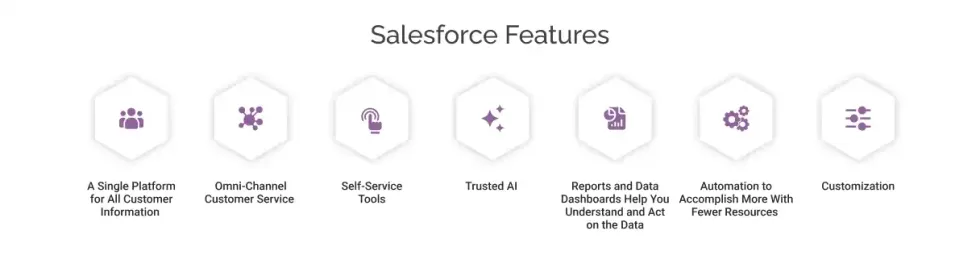 Measuring Training Effectiveness Salesforce Features
Integrated systems make it easier to assess the effectiveness of learning programs. Salesforce tracks sales results, and the LMS tracks progress through assessments and successful course completion. These platforms, combined, provide a holistic view of the impact of training on on-the-job performance. Organizations can modify their programs based on actual results, thus maximizing return on investment for every training dollar spent.
When employees feel engaged, they will complete training and apply new knowledge to their day-to-day jobs. Salesforce integrations can incorporate gamification features such as badges, leaderboards, or certifications to enhance employee engagement. These factors promote competition and provide badges for accomplishment, thus making the learning process more physically attractive. Workers are acknowledged and appreciated for their endeavors, making motivation and loyalty feel cemented.
Onboarding does not end with learning. Continuous improvement paves the road to success. A connected LMS and Salesforce also support continued development by recommending additional courses based on past performance and aspirations. It simplifies updating skills, as the right materials can be accessed without searching across multiple platforms.
Many organizations have to comply with some regulatory or industry standard, such as ISO certifications or data protection regulations like GDPR. Audits and compliance check-offs need accurate records. Integrating enables unified tracking of all learning activities and certifications. Managers can quickly generate reports without unnecessary stress during inspections. This trustworthiness safeguards both the workforce and the organization from possible compliance challenges.
Employees value opportunities for advancement. Managers can use data from both systems to create career paths for employees. When team members fulfill the necessary course requirements and meet sales goals, both of which prove they are eligible for new roles or skill sets, clear visibility into their progress allows people to plan their own growth and reach the next level within the organization.
Salesforce Integrations give multiple benefits to those who want to use a learning management program. All in all, improved data sharing makes work smarter, and with many solutions automating personalized learning and processes, it is a more valuable and engaging environment. This enables organizations to connect both these platforms to facilitate employee development, ensure better performance, and compliance with ease. The connection-based approach keeps learning relevant, measurable, and impactful to all stakeholders.
GearBrain Compatibility Find Engine
A pioneering recommendation platform where you can research,
discover, buy, and learn how to connect and optimize smart devices.
Join our community! Ask and answer questions about smart devices and save yours in My Gear.