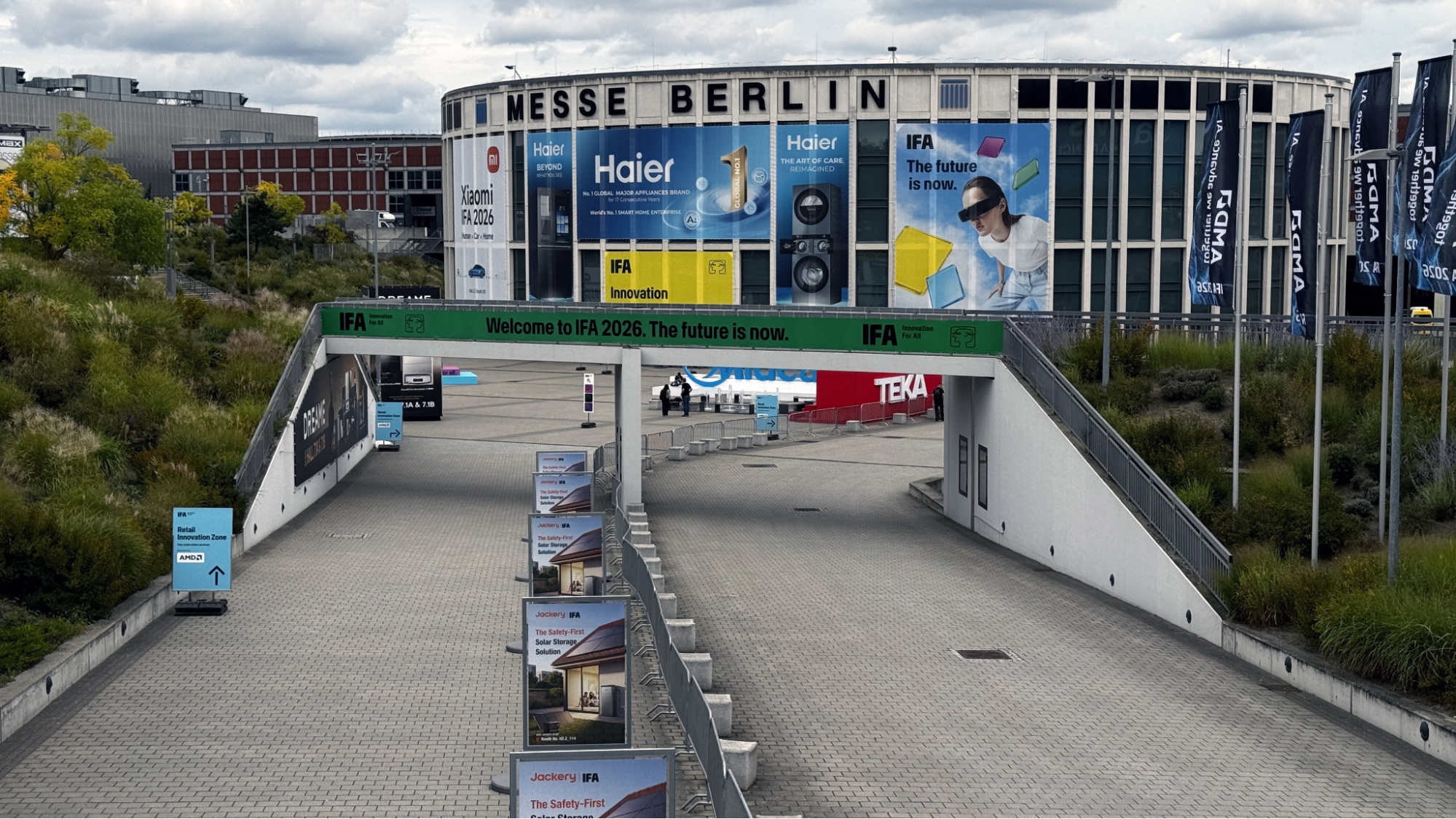
IFA 2026 once again turned Berlin into one of the most important stages for consumer technology, bringing together thousands of products spanning the smart home, artificial intelligence, appliances, computing, wearables, entertainment, and personal technology.
But the biggest story from IFA 2026 was not simply the number of new devices.
It was how quickly artificial intelligence and smarter automation are moving out of software and into the physical products people use every day.
We saw AI helping computers adapt to their owners, glasses translating conversations, robot vacuums tackling increasingly difficult cleaning problems, exoskeletons responding to human movement, and home appliances becoming more intelligent about how they consume energy.
At the same time, some of the products that impressed us most solved much simpler problems: keeping a phone cooler while it charges, making portable ice easier to use, extending the useful life of a power bank or improving the sound coming from a premium television.
Those are the kinds of innovations GearBrain looks for when selecting our Editor’s Choice Awards.
A product does not need AI simply for the sake of having AI. It needs to use technology in a way that provides a meaningful benefit to the person buying it.
Here are GearBrain’s Editor’s Choice Award winners from IFA 2026.
DREO Whole-Room Heater 720S

DREO Whole-Room Heater 720S
Dreo
Space heaters have traditionally been relatively simple appliances, but the DREO Whole-Room Heater 720S demonstrates how connected technology can make even basic home climate products smarter.
The compact heater is designed to operate either as a targeted personal heater or to distribute warm air throughout a room. Its adjustable airflow system can automatically change between focused heating and 360-degree distribution without requiring the user to reposition the heater.
DREO says the heater can begin producing heat in about two seconds while operating as quietly as 25 dB. It also integrates with the DREO app and the company's broader DREO Air Intelligence ecosystem.
That larger ecosystem is particularly interesting to GearBrain. Instead of treating heaters, fans, air conditioners and air purifiers as independent devices, DREO is working toward having them cooperate around factors such as temperature, humidity and air quality.
Matter compatibility is also planned, potentially making the heater easier to integrate with other smart home products.
Why it won: DREO is taking an appliance that has changed relatively little over the years and turning it into a more adaptive component of the connected home.
ESR Cyclone 25W Magnetic Charging Pad with CryoBoost
 Cyclone 25W Magnetic Charging Pad with CryoBoost - Black - 1 Set
ESR
Wireless charging is convenient, but heat remains one of its biggest weaknesses. As charging speeds increase, managing that heat becomes increasingly important.
The ESR Cyclone 25W Magnetic Charging Pad with CryoBoost addresses the problem directly.
The compact magnetic charger supports Qi2 25W charging and incorporates ESR's CryoBoost active cooling technology. A small fan moves air across the back of the phone while it charges, helping prevent the temperature increases that can cause a smartphone to throttle its charging speed.
The charger also includes an adjustable kickstand, allowing a phone to remain visible while charging.
It is an excellent example of solving a practical problem rather than simply increasing a specification.
Why it won: Faster wireless charging isn't very useful if heat forces the phone to slow down. ESR's combination of Qi2 25W charging and active cooling tackles that problem in an unusually compact design.
Euhomy Ice Leopard X1 Portable Rapid Ice Maker
 Ice Leopard X1 Portable Rapid Ice Maker
Ice Leopard X1
Countertop ice makers are increasingly popular, but the Euhomy Ice Leopard X1 stood out because Euhomy thought about what happens after the ice leaves the machine.
The X1 can produce bullet ice in as little as five minutes per cycle and make as much as 33 pounds per day. But its most interesting feature is its removable insulated ice bucket.
Instead of requiring users to transfer the ice into another container, the bucket itself can be removed and used for serving or taken to a patio, home bar or table. Euhomy says the insulated container can keep ice cold for up to four hours without power.
The machine also connects to an app for scheduling and remote status monitoring.
Why it won: The detachable insulated bucket solves a surprisingly obvious problem with countertop ice makers and makes the appliance more useful for entertaining and outdoor use.
Motorola Moto Watch Ultra
 Motorola Moto Watch Ultra watch material and different bands
anpoimages.com
Motorola made a significant return to the premium smartwatch category at IFA with the Moto Watch Ultra.
The 46mm stainless-steel smartwatch uses a 1.5-inch OLED display capable of reaching up to 2,700 nits of brightness and runs Google's Wear OS on Qualcomm's Snapdragon W5+ Gen 1 platform.
That means users can access Google services and apps including Google Maps, Google Wallet, YouTube Music, Google Messages and Gemini.
Motorola also continues its relationship with Polar for fitness and wellness insights covering areas including exercise, sleep, stress and heart rate.
LTE eSIM support allows the watch to remain connected without a smartphone nearby, while IP68 and 5ATM ratings help protect it during workouts and swimming.
Motorola rates battery life at up to two days with the always-on display disabled, while a 15-minute charge can provide up to 24 hours of use.
Why it won: Motorola combined Wear OS, Google's ecosystem, Polar health technology, and cellular connectivity in a watch that represents a significant step forward for its wearable platform.
Hypershell Halo

Hypershell Halo
Hypershell
One of the most futuristic products at IFA 2026 was also one of the most fascinating.
The Hypershell Halo is a full-leg consumer exoskeleton designed to assist people while walking, hiking, climbing and navigating difficult terrain.
Unlike earlier systems that primarily assisted the hips, Halo coordinates four powered hip and knee joints as one system.
Its HyperDrive Pro four-motor system can deliver up to 1,490 watts of peak output, while Hypershell says the system can reduce knee-muscle fatigue by as much as 40 percent in certain movements.
More than 30 sensors and the company's HyperIntuition 2.0 technology help the system anticipate and respond to the wearer's movements.
Despite all that hardware, Halo weighs about 2.6 kg, or roughly 5.7 pounds, and folds into a volume of less than eight liters. Its removable battery provides up to 20 kilometers of range.
Why it won: Halo provides a glimpse at how wearable robotics could eventually augment human movement instead of replacing it. The technology has moved from a science-fiction concept toward a product consumers can actually wear.
INMO GO3 AI Glasses

INMO GO3 AI Glasses
INMO
Smart glasses were everywhere at IFA 2026, but the INMO GO3 showed how the category can become genuinely useful without turning glasses into oversized headsets.
At just 58 grams, the GO3 incorporates binocular Micro-LED displays that place information directly in the user's field of view.
Translation is one of its standout features. The glasses support real-time translation across dozens of languages, displaying translated speech as subtitles in front of the wearer.
The GO3 can also provide navigation through HERE Maps, work as a teleprompter, capture information from conversations, and access AI assistants.
Another clever design decision is the use of interchangeable magnetic batteries, allowing users to swap power instead of waiting for the glasses themselves to recharge.
Why it won: INMO is moving smart glasses beyond novelty by focusing on practical everyday applications, including translation, navigation, and information access.
JMGO IRIS Ultra Max

JMGO IRIS Ultra Max
JMGO
Home projectors increasingly compete with large televisions, but gaming has remained an area where TVs typically hold an advantage.
The JMGO IRIS Ultra aims to change that.
JMGO says the projector can deliver native 4K video at up to 120Hz, making it particularly attractive for gaming and sports.
Its MALC 6.0 RGB triple-laser system is rated at 6,500 ISO lumens, while a dual mechanical iris system helps achieve a claimed 10,000:1 native contrast ratio.
Gamers get variable refresh rate support and Auto Low Latency Mode, while Dolby Vision is supported at 4K/120Hz.
The projector also incorporates a motorized AI-powered gimbal, optical zoom, and automated screen alignment to make installation considerably more flexible.
Why it won: Combining 4K resolution, a 120Hz refresh rate, strong brightness, and flexible automated positioning addresses several of the traditional compromises buyers make when choosing a projector instead of a television.
Laifen AutoCurl Curling Iron

Laifen AutoCurl Curling Iron
Reviewed.com
Laifen brought automation and sensor technology into personal grooming with its AutoCurl Curling Iron.
Instead of requiring users to manually wrap their hair around a heated barrel, AutoCurl uses a direct time-of-flight sensor to detect the position of the hair and automatically guide it into the curling chamber.
A micro-servo motor monitors resistance and can stop or adjust the mechanism if it detects a snag, helping reduce pulling and potential damage.
Dual PTC heating elements provide controlled heating, while Laifen says the system can create a curl in approximately 16 seconds.
The company also incorporates negative-ion technology designed to reduce frizz.
Why it won: AutoCurl applies sensing and automation to simplify a familiar beauty routine while adding safeguards designed to protect the user's hair.
Plaud One

Plaud One
Plaud
Generative AI is changing how people take notes, and Plaud One represents the next step in Plaud's effort to move AI recording from a dedicated device into something people can wear throughout the day.
Plaud One combines earbuds with Plaud's AI transcription and productivity platform.
Users can capture conversations and meetings, have them transcribed and summarized, and turn the information into actionable notes through Plaud's AI software.
More importantly, Plaud is positioning One as a wearable AI assistant rather than simply an audio recorder. The idea is to allow people to capture information and interact with their assistant naturally through voice instead of repeatedly opening an app.
Why it won: Plaud One demonstrates where AI productivity devices are heading: away from dedicated recorders and toward assistants that can remain available throughout the user's day.
iRobot Roomba Max 875 Combo
iRobot Roomba Max 875 Combo
Multivu
Robot vacuums have become one of the most competitive smart home categories, forcing manufacturers to solve increasingly difficult cleaning problems.
The iRobot Roomba Max 875 Combo introduces several interesting approaches.
Its new SealForce technology lowers a skirt around the vacuum when cleaning carpet, concentrating airflow against the floor rather than allowing suction to escape around the robot. The system is paired with suction rated at up to 35,000 Pa.
The Max 875 Combo can also vacuum and mop. Its ThermaMist system applies heated mist to help loosen difficult stains, while the dock can automatically clean and dry the roller mop.
LiDAR and cameras handle navigation and obstacle detection.
iRobot has also said the new generation supports Alexa, Google Home and Siri, with Matter certification in progress.
Why it won: Instead of competing only on suction numbers, iRobot redesigned how the vacuum interacts with carpet and stains — two areas where robot cleaners still struggle compared with traditional cleaning.
RayNeo GT Max AR Glasses
 RayNeo GT Max AR Glasses 1
Android Authority
While INMO GO3 focuses heavily on information and AI, RayNeo GT Max demonstrates another possible future for glasses: replacing screens.
RayNeo's AR glasses can create the equivalent of a massive 267-inch virtual display with a 59-degree field of view.
They use the company's Peacock Optical Engine 3.0 Max and are billed as the world's first Dolby Vision-certified AR glasses.
A dual-chip architecture handles display processing and 3DoF head tracking so virtual content can remain positioned in space as the wearer moves.
Audio is equally ambitious. RayNeo partnered with Bang & Olufsen on a four-speaker system with spatial audio and head tracking.
And all of that comes in glasses weighing approximately 78 grams.
Why it won: RayNeo GT Max shows how lightweight AR glasses could eventually provide a portable alternative to televisions, monitors and other physical displays.
Sonoff TRV Smart Thermostat Radiator Valve
 SONOFF Zigbee Thermostatic Radiator Valve
itead.cc
Some of the most useful smart home products aren't the flashiest.
The TRV Smart Thermostat Radiator Valve recognized by GearBrain at IFA represents an important category because smart radiator valves can bring room-by-room temperature control to homes that rely on traditional radiator heating.
Instead of controlling the entire home from a single thermostat, a connected TRV can regulate individual radiators based on room temperature, schedules and user preferences.
That makes it possible to reduce heat in unused rooms while maintaining comfortable temperatures where people are actually spending time.
Why it won: Smart radiator controls demonstrate one of the strongest arguments for home automation: using connectivity to improve comfort while potentially reducing unnecessary energy consumption.
Belkin UltraCharge Pro Slim Magnetic Power Bank 5K

Belkin UltraCharge Pro Slim Magnetic Power Bank 5K
Belkin
Battery innovation doesn't always get the attention given to processors and displays, but Belkin's UltraCharge Pro Slim Magnetic Power Bank 5K with BoostSolid Cell could be more important to everyday consumers than many headline-grabbing technologies.
Belkin uses what it calls BoostSolid Cell technology, a semi-solid-state battery design intended to provide greater stability, improved temperature management and a longer useful lifespan.
Belkin claims the battery can last up to three times longer than conventional liquid-cell designs.
The 5,000mAh power bank is only about 8.4mm thick, supports Qi2 magnetic wireless charging at up to 15W, and can deliver up to 22.5W through USB-C.
Belkin also incorporates temperature monitoring that checks conditions every 20 milliseconds.
Why it won: Instead of simply adding capacity, Belkin focused on longevity, safety, and size — three factors that could ultimately matter more to portable power users.
Lenovo IdeaCentre AIO i
Lenovo IdeaCentre AIO i
Lenovo
The desktop computer isn't disappearing. Lenovo thinks it simply needs to adapt to the modern home.
The new Lenovo IdeaCentre AIO i combines computing, entertainment and AI features in a streamlined all-in-one design available with 23.8- and 27-inch displays.
Intel Core Series 3 processors provide up to 40 platform TOPS of AI performance, while Lenovo's AI Turbo Engine brings together performance optimization, multimedia enhancements and adaptive features.
One of the more unusual additions is Adaptive Lighting, which can change based on startup, normal use or music playback.
Lenovo also redesigned the computer to eliminate the bulky processing enclosure commonly found behind all-in-one displays.
The stand provides height and tilt adjustment, while select configurations can include a 5MP IR camera, physical privacy shutter, wireless charging and touchscreen functionality.
Why it won: Lenovo is rethinking the family desktop as a piece of connected home technology rather than simply a PC with the computer hidden behind the screen.
Samsung HiFi S99H with Canvas L

Samsung HiFi S99H with Canvas L
Samsung
TVs have become remarkably thin, but that creates a fundamental audio problem: great speakers need space.
Samsung's collaboration with Danish audio company Canvas HiFi offers an interesting solution.
The premium Samsung HiFi S99H combines Samsung's flagship OLED display technology with an integrated Canvas HiFi audio system.
The larger Canvas L configuration can provide as much as 1,500 watts of Class D amplification and uses Baach 3D audio processing to create a more immersive listening experience.
The system is designed to look like part of the television rather than a separate soundbar sitting underneath it.
Configurations are expected for 55-, 65-, 77- and 83-inch Samsung OLED displays.
Why it won: Instead of accepting mediocre sound as the price of an ultra-thin television, Samsung and Canvas are attempting to make premium audio part of the TV itself.
DJI Osmo 360 II

DJI Osmo 360 II
DJI
DJI used IFA 2026 to push 360-degree imaging further with the Osmo 360 II.Osmo 360 II.
The camera uses a new 1-inch square HDR imaging sensor and can record 360-degree video at up to 8K/60fps.
DJI says the new sensor architecture improves sensor utilization while increasing dynamic range to as much as 14.5 stops.
Low-light recording also receives an upgrade through AI SuperNight 2.0.
Perhaps more important for people who actually use 360 cameras outdoors is a new replaceable lens design. Scratching one of the protruding lenses on a 360 camera can be an expensive mistake, so allowing damaged lenses to be replaced addresses a real-world weakness of the category.
The 183-gram camera also includes 105GB of built-in storage, a four-microphone array and direct support for DJI's wireless microphone ecosystem.
Why it won: DJI combined significant imaging improvements with a practical replaceable-lens system that addresses one of the biggest vulnerabilities of 360-degree cameras.
Midea Tri-GreenApex System
Midea Tri-GreenApex System
Midea
Energy efficiency was another important theme at IFA 2026, and Midea's Tri-GreenApex System stood out for rethinking what happens after a dishwasher finishes cleaning.
The system combines washing, drying, and long-term dish storage into one process.
Midea says Tri-GreenApex can consume approximately 50 percent less energy than Europe's highest A-rated standard while providing express drying in about 30 minutes.
More unusually, the system is designed to keep dishes dry for as long as 168 hours.
That means consumers don't necessarily need to empty the dishwasher immediately after a cycle ends, helping turn the appliance into temporary clean-dish storage.
Why it won: Midea looked beyond the washing cycle and addressed the entire process of cleaning, drying and storing dishes while putting energy efficiency at the center of the design.
What GearBrain's IFA 2026 winners tell us about the future of consumer technology
Looking across GearBrain's Editor's Choice winners, one theme stands out: technology is becoming less about individual gadgets and more about devices understanding what users are trying to accomplish.
The Hypershell Halo senses how someone is moving and adjusts its assistance. INMO GO3 can put translated conversations directly into someone's field of view. Plaud One turns spoken conversations into useful information. DREO is working toward an environment where climate products coordinate around conditions in the home.
Meanwhile, iRobot is redesigning how a robot vacuum physically interacts with carpet, DJI is making vulnerable camera lenses replaceable, Euhomy turned an ice bucket into part of the appliance, and Belkin is trying to make the battery inside a power bank last significantly longer.
Those may sound like unrelated innovations, but they have something important in common.
The best technology at IFA 2026 wasn't technology looking for a problem. It was technology designed around a problem consumers already have.
That distinction will become increasingly important as AI works its way into virtually every consumer electronics category.
For GearBrain, the next generation of smart products won't be defined simply by how many devices can connect to an app or whether a manufacturer can put the letters "AI" on the box. What matters is whether those technologies make devices easier to discover, install, connect, control and live with.
Our IFA 2026 Editor's Choice Award winners offer a strong indication of where that future is heading.
From Your Site Articles
Related Articles Around the Web


 Cyclone 25W Magnetic Charging Pad with CryoBoost - Black - 1 Set
 Ice Leopard X1 Portable Rapid Ice Maker
 Motorola Moto Watch Ultra watch material and different bands


 RayNeo GT Max AR Glasses 1
 SONOFF Zigbee Thermostatic Radiator Valve