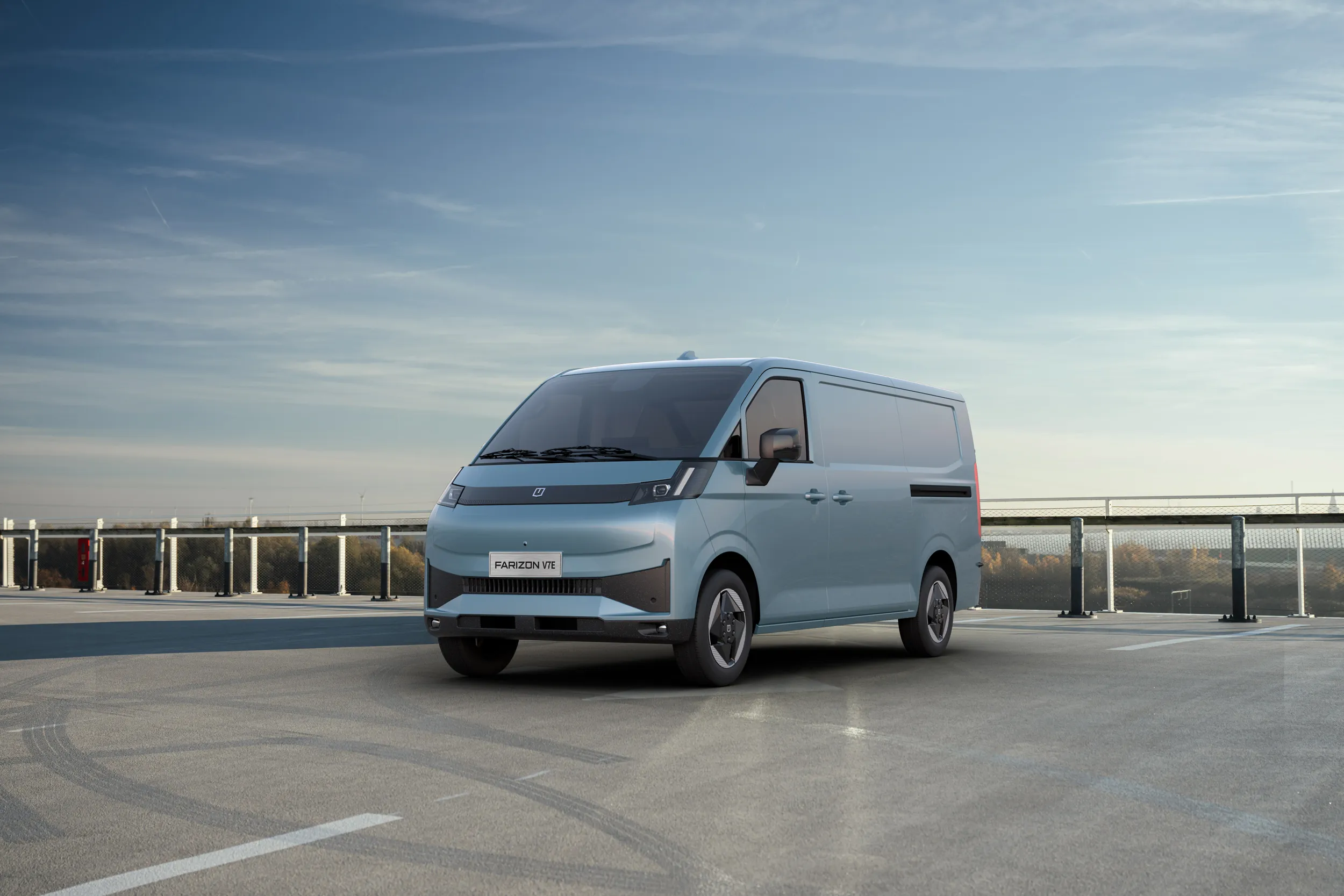
In almost every city job, you reach a point where you stop caring how impressive your van looked in the showroom. You’re wedged beside a ute, a delivery rider has stopped behind you, and the customer insists there’s “plenty of room down the side”. There isn’t. For businesses that spend most of their time in crowded suburbs, the appeal of a compact electric work van becomes pretty obvious. The Farizon V7E is designed around urban commercial use, with 6.95 cubic meters of cargo space, a low loading floor and a relatively compact footprint for constant city driving.
The parking spot nobody warned you about
Imagine you’re doing appliance repairs around Sydney.
First job is easy. Wide street. Driveway out front. Lovely.
The second customer lives above a row of shops. There’s a loading zone, but someone is already sitting in it, hazard lights blinking as though that magically makes everything legal.
Then there’s a basement car park.
Then a narrow laneway.
Then you’re trying to reverse somewhere while a person in a Corolla watches from two meters away, without offering even the slightest help.
This is normal city work.
And it’s exactly why buying the largest van you can afford isn’t always the smartest move.
A big van gives you more room, sure. But if you’re carrying tools, parcels or service equipment rather than sofas and building materials, you may be dragging around empty space that makes every tight turn slightly harder.
The V7E uses a 3,200 mm wheelbase and is pitched specifically at urban delivery, courier work and service businesses.
That’s the useful bit.
It isn’t trying to be everything.
Measure the weirdest thing you carry
 Measure the weirdest thing you carryGoogle
Before buying any commercial van, do this wonderfully low-tech exercise.
Grab a tape measure.
Go to your current van and find the most annoying item you regularly carry.
Maybe it’s a folding ladder. Maybe it’s a toolbox that never quite fits where you want it. Perhaps you’ve got a length of equipment that's spent the past three years sitting diagonally across the cargo area because nobody thought about it when they installed the shelving.
Measure that.
The V7E offers more than 2.86 meters of internal load length. Its cargo area holds 6.95 cubic meters.
Now compare those numbers with your actual gear.
Not what you think you carry.
What you really carry.
There’s a difference.
Weight is the bit people forget
Cargo space is nice because you can see it.
Payload is easier to ignore.
That can become a problem for businesses carrying dense equipment. Tools, fittings, electrical gear and building products add weight much faster than most people realize.
Farizon offers two versions of the V7E. The Standard Range model has a 50 kWh battery, a quoted WLTP range of 240 km and payload capacity of 1,338 kg. The Extended Range version uses a 66 kWh battery, increasing quoted WLTP range to 329 km while reducing payload to 1,208 kg.
That trade-off is worth noticing.
Want more range?
Fine.
But you don’t automatically get more of everything.
That’s useful when choosing a work vehicle because different businesses care about different numbers.
A parcel courier might happily favor range.
A contractor hauling heavy equipment might look at the higher payload and think, yep, that’s the one.
Low floors become surprisingly exciting
 Low floors become surprisingly exciting farizon v7e 4
The V7E has a rear load height of 510 mm.
Not exactly something you’d brag about at a barbecue.
Until you’ve loaded a van fifty times in one day.
Think about the movement involved. Door open. Step up. Grab box. Step down. Deliver it. Walk back. Climb in again.
Repeat until your knees start sending strongly worded complaints.
A lower loading height can make that repetitive work easier, especially when drivers manually move parcels or tools throughout the day.
It also helps when the thing you’re lifting is awkward rather than especially heavy.
You know the type. Big enough that you can’t see your feet, and shaped like it was deliberately designed to catch every doorframe on the way through.
Electric makes more sense when stopping is the job
City vans don’t really drive in the traditional sense.
They lurch.
Twenty meters. Stop.
Three hundred meters. Stop.
Traffic lights.
Roundabout.
Someone parallel parking at roughly the speed continental drift occurs.
Then another stop.
Electric motors suit this kind of work because they deliver torque immediately and don’t need a combustion engine to idle while the van sits still. Farizon also highlights quieter operation as one of the V7E’s advantages for early starts and dense urban areas.
That last point sounds small. But it isn’t always.
A bakery making deliveries before sunrise, a maintenance company working around apartment buildings or a courier arriving early in a residential street all create enough noise already.
Roller doors are noisy.
Trolleys are noisy.
Drivers dropping something metallic at 6:20 am are extremely noisy.
Removing engine noise from that equation isn’t a bad thing.
Range should match the route, not your imagination
 Range should match the route, not your imaginationGoogle
This is where people can overthink electric vehicles.
They imagine the longest possible drive they might ever make and shop around that.
But commercial vehicles often follow surprisingly predictable patterns.
Check your last month of driving.
If the van normally covers 80 to 140 km per day and returns to the same place every evening, that tells you something useful.
If it regularly travels 250 km and gets unexpected jobs added during the afternoon, that tells you something else.
Farizon’s 329 km figure applies to the Extended Range version under WLTP test conditions. Actual range can vary with payload, temperature, terrain, driving style, battery age, and other factors.
So leave yourself some margin.
Naturally.
The point isn’t to see how close you can get to zero every afternoon.
Small vans should make boring jobs easier
That’s probably the best way to judge one.
Can you park it without turning the job into an event?
Can you fit the equipment you genuinely use?
Can it carry the weight?
Will the route fit comfortably within its working range?
And when you open the rear doors for the thirty-fifth time that day, is getting your stuff out reasonably painless?
Those questions aren’t very glamorous.
But work vehicles aren’t supposed to be glamorous.
They’re supposed to make an already busy Tuesday slightly less annoying.
And in a crowded city, being smaller in the right places can be a very useful advantage.
From Your Site Articles
Related Articles Around the Web
 Measure the weirdest thing you carryGoogle

 Low floors become surprisingly exciting
 Range should match the route, not your imaginationGoogle