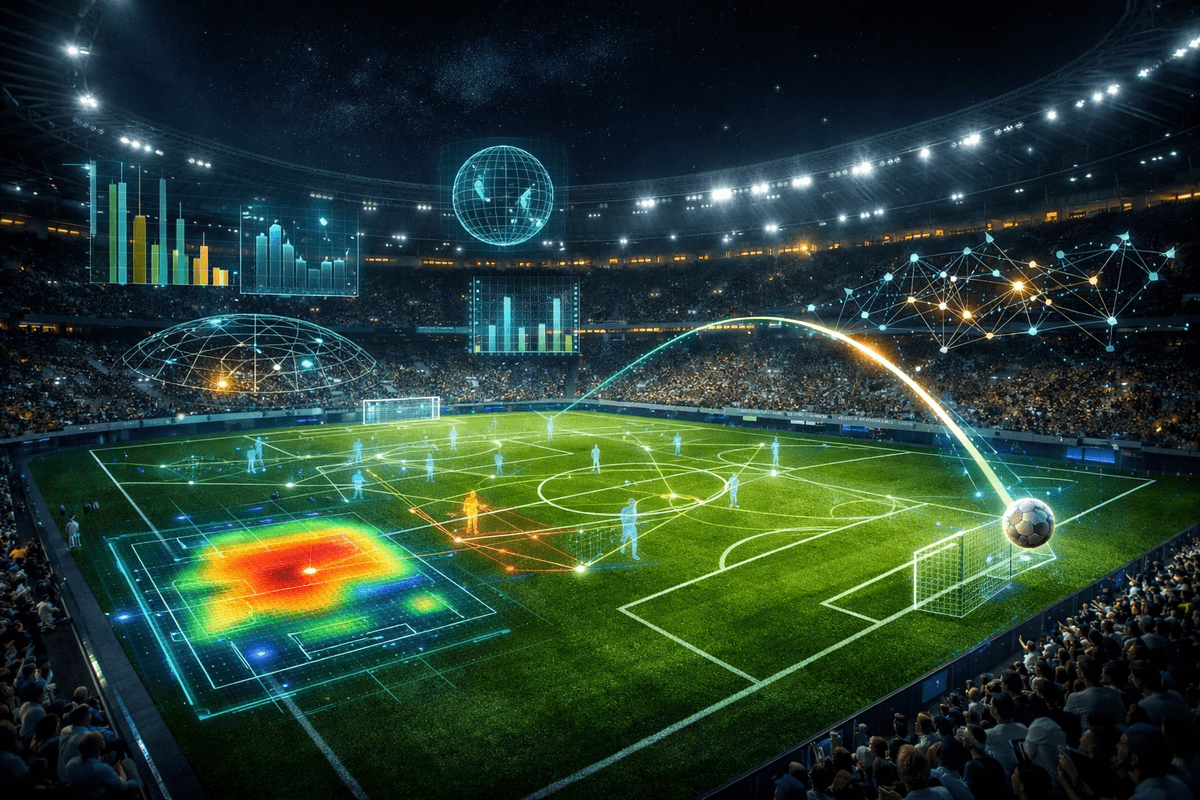
an illustraction of soccer field with augmented reality players.
Google

The 2026 FIFA World Cup Is the Most Data-Dense Sporting Event Ever Built

How the 2026 FIFA World Cup is powered by advanced data, AI, and IoT systems, transforming football into a real-time, analytics-driven experience.

Like GearBrain on Facebook

48 teams. 104 matches. Three host nations across the United States, Canada, and Mexico. The 2026 FIFA World Cup is starting this June 11, and it is the largest edition of the tournament ever staged.

Most of the conversation around it involves squads, fixtures, and favorites. The part getting less attention is the data infrastructure beneath it all, which has scaled at a rate that makes previous tournaments look analog by comparison. Player tracking, AI officiating, smart stadium systems, and connected match equipment. The technology running this World Cup is load-bearing rather than just background noise.

Player tracking systems now generate positional data at 25 frames per second. Wearable sensors embedded in training vests monitor heart rate variability, sprint load, and muscle fatigue in real time. Computer vision systems map every touch, run, and defensive shape across 90 minutes without human input. The volume of structured data from each of the 104 games in 2026 is several orders of magnitude larger than anything available to coaches or analysts even a decade ago.

For the people who already follow connected devices and IoT infrastructure, this is familiar territory in a new context. The same sensor networks, edge computing pipelines, and machine learning models, aka AI, driving smart home automation, are the ones now running inside elite football.

What the Data Actually Changes for the Football Fans

a photo of tv remote with tv showing fifa soccess game What the Data Actually Changes for the Football Fans iStock

Player performance data has moved well beyond the analyst's spreadsheet, and moving forward, it will feed directly into the consumer-facing experience of following a tournament. Fantasy platforms, broadcast overlays, real-time statistics, and prediction tools all pull from the same underlying data streams that clubs use internally. When a broadcaster shows expected goals in real time during a match, that number is the output of a model trained on millions of historical shots, weighted by position, angle, defensive pressure, and goalkeeper positioning.

Betting markets respond to the same inputs, and this year they are expected to see the largest volume of bets ever placed compared with previous major sporting events. The latest World Cup odds reflect aggregated model output, injury data, squad-depth analysis, and recent form across club football rather than just bookmaker opinion.

This year, Spain sits as the tournament favorite at +450 according to ESPN's current odds board, with France and England at +600, Brazil and Argentina at +850. Those numbers shift as new information enters the market: a training ground injury, a squad announcement, a warm-up result. The speed at which odds adjust in 2026 is itself a product of how quickly data moves through the pipeline.


The Sensor Layer

The ball itself is a connected device. The official 2026 match ball contains an inertial measurement unit transmitting position data 500 times per second to a central tracking system. Most coverage of tournament technology focuses on what players wear. The ball has been generating data longer than anyone discusses.

Stadium infrastructure runs deeper than pitch-level. Venues across the US, Canada, and Mexico are running sensor networks that simultaneously monitor crowd movement, structural loads, and energy draw. Some of these facilities were already integrated with commercial IoT platforms before FIFA arrived. The World Cup is essentially running on top of smart building infrastructure that was built for something else entirely.

The semi-automated offside system that debuted at the 2022 Qatar World Cup uses 12 dedicated tracking cameras per stadium, combined with AI-driven skeletal mapping, to make real-time decisions. Every 2026 venue runs it. What took a linesman and a raised flag now takes milliseconds and a computer vision model trained on thousands of hours of match footage.

AI Prediction Models and Where They Actually Fall Short

Soccer ball with neon lights. AI Generated. Soccer ai generated illustrations AI Prediction Models and Where They Actually Fall Short Soccer ball with neon lights. AI Generated. Soccer ai generated illustrations

Machine learning models trained on historical tournament data have become genuinely sophisticated at identifying value in pre-tournament futures markets. They factor in squad age profiles, tournament experience, fixture difficulty, travel distances between host cities, and rest periods between knockout matches. In an expanded 48-team field with a new league-stage format replacing the traditional group stage, the path to the final is longer and more complex than any previous World Cup, which makes modeling tournament progression harder and the odds more volatile.

Where AI models consistently underperform is in accounting for the randomness that makes football worth watching. A goalkeeper is having the match of his life. A red card in the 30th minute of a quarterfinal. A penalty shootout. None of those outcomes is predictable by any model with useful accuracy, and they are precisely the moments that decide World Cups. Spain's +450 implies roughly an 18% probability of winning the tournament. That 82% probability of not winning is where most of the interesting betting decisions live.

For anyone tracking odds as tournament data rather than just as a betting mechanism, watching how markets respond to real-world events in June and July will be as instructive as anything happening on the pitch.


Like GearBrain on Facebook
The Conversation (0)

GearBrain Compatibility Find Engine

A pioneering recommendation platform where you can research, discover, buy, and learn how to connect and optimize smart devices.

Join our community! Ask and answer questions about smart devices and save yours in My Gear.

Top Stories

Weekly Deals