The Conversation (0)
iStock
What Hardware Startups Need to Know About Manufacturing Their First Product
A practical guide to turning prototypes into scalable hardware products
Building a hardware startup is different from building a software company. Software can be updated, patched, and redeployed in minutes. Hardware ships in a box, and if something is wrong with it, you cannot push a fix. The product either works or it does not.
Most first-time hardware founders underestimate how much of the journey happens after the prototype is finished. Getting from a working prototype to a manufacturable product involves decisions about materials, tolerances, suppliers, tooling, and logistics that software founders never have to consider.
These decisions determine whether a product ships on time, works reliably, and costs what the business plan predicted. The following sections outline the hardware requirements startups need to understand before committing to production.
A prototype proves that something can work. A product proves it can perform thousands of times in the hands of real users after being manufactured at scale and shipped worldwide.
The gap between these two states is larger than most founders expect. A 3D-printed enclosure that works fine on a demo unit may warp, crack, or discolor when injection molded in production plastics. A circuit board hand-soldered in a lab may behave differently when assembled by automated pick-and-place machines. A battery that lasts eight hours in testing may drain in four hours after sitting in a hot warehouse for two months.
Design for manufacturability is the discipline of engineering products that can actually be produced at scale. This means selecting materials that behave consistently in production, designing parts that can be assembled without excessive manual labor, and specifying tolerances that balance precision against cost.
Founders who skip this step often discover problems during the first production run, when fixing them is most expensive.
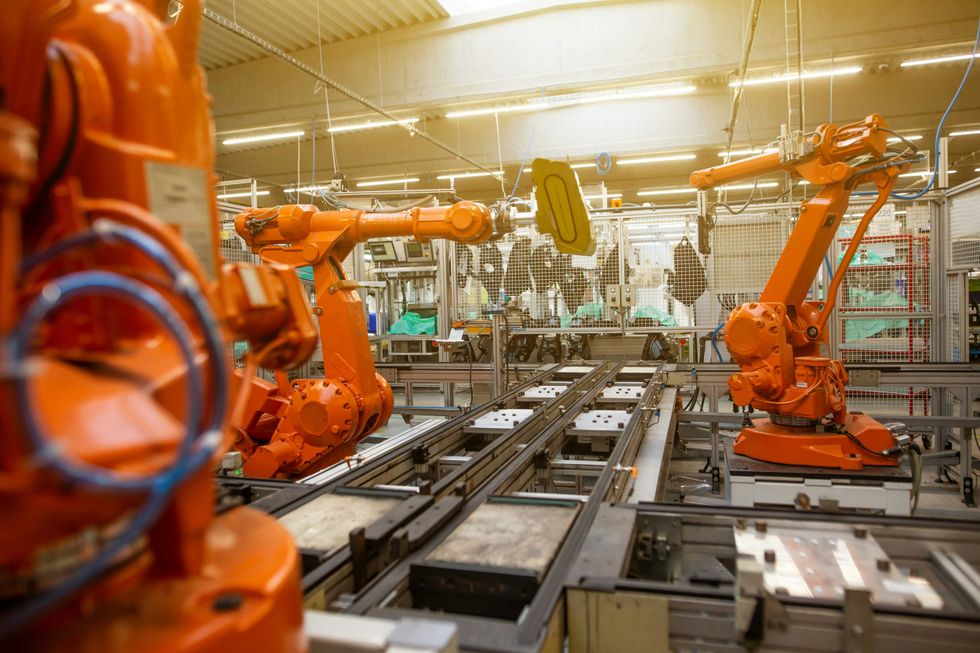 a factory filled with lots of orange machines Photo by Simon Kadula on Unsplash
Manufacturing a hardware product requires partners capable of producing components, assembling them, and delivering finished goods. For most startups, this means working with contract manufacturers rather than building in-house production capabilities.
The search for manufacturing partners often starts with custom parts. Enclosures, brackets, heat sinks, and other mechanical components typically require CNC machining, injection molding, or sheet metal fabrication. Electronic components come from different suppliers than mechanical parts. Final assembly may happen at yet another facility.
China remains the dominant manufacturing hub for hardware startups due to its cost, speed, and concentration of suppliers in regions such as Shenzhen.
Platforms like Haizol connect startups with verified manufacturers for CNC machining, injection molding, die casting, and other fabrication services. The platform vets suppliers before listing them and assigns account managers to manage communication, reducing the risk of working with unknown overseas factories.
Startups with larger budgets sometimes work with full-service contract manufacturers who handle everything from component sourcing through final assembly and shipping. Companies like Flex, Jabil, and smaller regional players offer turnkey manufacturing, though minimum order quantities and setup costs can be prohibitive for early-stage companies.
The key is matching manufacturing partners to production volume. A supplier who excels at prototypes and small batches may not be equipped for high-volume production. A factory optimized for runs of 100,000 units may not be interested in an initial order of 500.
Injection molding, die casting, and stamping all require custom tooling. These tools are metal molds or dies that shape raw materials into finished parts. They are expensive to produce, and their cost must be amortized across the production run.
A simple injection mold for a plastic enclosure might cost $5,000 to $15,000. A complex, multi-cavity mold for high-volume production can cost over $100,000. Die casting tools for metal parts carry similar price tags. These costs are incurred before any production part is made.
Tooling decisions also lock in design choices. Changing a part after tooling is complete means modifying or replacing the tool, which adds cost and delays. Startups that finalize tooling before fully validating their design often regret it.
The practical approach is to delay tooling as long as possible. Use 3D printing, CNC machining, or soft tooling for early production runs while the design stabilizes. These methods cost more per part but avoid the upfront tooling investment. Once the design is proven and demand is established, invest in production tooling to reduce per-unit costs.
The bill of materials is the complete list of components that go into a finished product. Every resistor, screw, label, and packaging insert appears on the BOM along with its cost and supplier.
BOM cost is the floor for product pricing. Whatever the final retail price, it must cover BOM cost plus manufacturing labor, shipping, duties, marketing, support, returns, and profit margin. Startups frequently underestimate BOM costs during fundraising and later discover that their target price point is impossible to hit.
Component selection drives BOM cost more than most founders realize. A slightly smaller capacitor, a different connector, or an alternative microcontroller can shift costs significantly at scale. Engineers who design products without considering component costs often create BOMs that make the business model unworkable.
Sourcing also matters. The same component from different distributors can vary in price by 20-30%. Volume commitments, payment terms, and supplier relationships all affect what startups actually pay. Building relationships with component distributors early gives startups leverage when it comes time to negotiate production pricing.
Products that contain electronics, wireless radios, or batteries require regulatory certifications before they can be legally sold. In the United States, FCC certification covers radio frequency emissions. UL certification addresses electrical safety. Products with Bluetooth or Wi-Fi require additional certifications from the respective organizations.
International sales require additional certifications. CE marking for Europe, IC for Canada, MIC for Japan, and various other regional requirements all add time and cost to the launch process.
Certification testing typically costs $10,000 to $50,000, depending on product complexity and the certifications required. The process takes weeks or months. Products that fail testing must be redesigned and retested.
The mistake startups make is treating certification as a final checkbox rather than a design constraint. Products should be designed with certification requirements in mind from the beginning. Layout decisions on circuit boards, shielding choices, antenna placement, and power supply design all affect whether a product passes certification testing.
Involving a certification consultant early in the design process prevents expensive surprises later.
Hardware products increasingly need to work with other devices and platforms. A fitness tracker needs to sync with smartphones. A smart home device needs to integrate with Alexa, Google Assistant, or HomeKit. A connected appliance needs to communicate with other devices in the home.
This interoperability adds complexity that pure hardware companies often underestimate. Software development, cloud infrastructure, API integrations, and ongoing platform updates all require resources beyond hardware. Products that work flawlessly in isolation may struggle when users try to integrate them into existing ecosystems.
The smart home market illustrates this challenge clearly. Devices must work across multiple wireless protocols, voice assistants, and manufacturer ecosystems. A product that only works with one platform limits its addressable market. A product that promises broad compatibility but delivers a frustrating experience generates returns and negative reviews.
Startups building connected products should define their integration strategy early. Which platforms will be supported at launch? Which will come later? What are the technical requirements for each integration? These decisions affect hardware design, firmware development, and ongoing operational costs.
 Types of Auto Transport Services iStock
Defective products destroy hardware startups. Returns are expensive. Negative reviews damage sales. Warranty claims eat into margins. And unlike software bugs, hardware defects cannot be fixed remotely.
The history of crowdfunded hardware products is littered with examples of companies that shipped products before they were ready, damaging their brands and disappointing backers who waited months or years for delivery.
Quality control starts with specifying what acceptable quality looks like. This means defining tolerances, cosmetic standards, and functional test criteria before production begins. Suppliers need clear documentation of what passes and what fails.
Inspection should happen at multiple stages. Incoming component inspection catches defective parts before they are assembled into products. In-process inspection identifies problems during assembly while there is still time to correct them. Final inspection before shipping verifies that finished products meet specifications.
For startups manufacturing overseas, third-party inspection services provide independent verification of quality before products ship. Companies such as SGS, Bureau Veritas, and Intertek offer inspection services across manufacturing regions worldwide. The cost of inspection is small compared to the cost of shipping defective products to customers.
Hardware startups must purchase components and cover manufacturing costs before receiving customer payments. This gap creates working capital requirements that software startups do not face.
Component lead times exacerbate this challenge. Some parts require ordering months in advance. Memory chips, microcontrollers, and specialized components can have lead times of 20 weeks or more. Startups must commit capital to inventory well before they know the actual customer demand.
The tension between inventory investment and cash conservation is constant. Ordering too much inventory ties up capital and creates risk if products do not sell. Ordering too little leads to stockouts that frustrate customers and damage growth.
Forecasting demand for a new product is inherently uncertain. Conservative startups start with smaller production runs, accept higher per-unit costs, and scale production as demand becomes clearer. This approach preserves cash and reduces risk at the expense of unit economics.
A product that arrives damaged is a failed product regardless of how well it was manufactured. Packaging must protect products through warehouse handling, truck transport, air freight, customs inspection, and last-mile delivery.
For startups distributing locally or regionally, fulfillment coordination can become just as critical as manufacturing itself. Platforms such as Metrobi help food, beverage, and wholesale businesses manage last-mile delivery operations without building their own logistics infrastructure from scratch.
Packaging design is engineering work. Drop testing, compression testing, and environmental testing validate that packaging protects products under realistic shipping conditions. Products with screens, moving parts, or fragile components require more protective packaging than solid-state electronics.
Shipping costs also affect business economics. Dimensional weight pricing means that large, lightweight products cost more to ship than their actual weight would suggest. Packaging that reduces box dimensions can significantly reduce shipping costs at scale.
Customs and duties add complexity to international shipping. Tariff classifications, country-of-origin declarations, and import documentation all require attention. Products that clear customs quickly reach customers faster and generate fewer support inquiries.
Hardware is hard for good reasons. Physical products must operate reliably in unpredictable environments, withstand shipping and handling, and comply with regulatory requirements before reaching customers. The founders who succeed take these constraints seriously from the beginning rather than treating them as problems to solve later.
The path from idea to product involves more partners, more capital, and more time than most first-time founders expect. But the reward is a product that customers can hold in their hands, a business with real margins and defensible differentiation, and the satisfaction of building something that exists in the physical world.
GearBrain Compatibility Find Engine
A pioneering recommendation platform where you can research,
discover, buy, and learn how to connect and optimize smart devices.
Join our community! Ask and answer questions about smart devices and save yours in My Gear.