For years, augmented reality glasses have promised to replace televisions, monitors, and even laptops by putting a giant virtual display in front of your eyes. Most have fallen short because they were either uncomfortable, difficult to set up, or simply too expensive for everyday consumers.
After spending several weeks using the Rokid Max 2 in the real world—from a long business trip to China to watching movies in my living room, working in my office, and gaming with handheld devices—I came away impressed.
The Rokid Max 2 isn't trying to be another AI assistant or mixed-reality headset like Apple Vision Pro. Instead, it focuses on doing one thing extremely well: giving you a massive private screen that travels anywhere you do.
At their current sale prices of $299 on Amazon and $309 on Rokid.com, the value proposition is considerably stronger than when these glasses debuted at a $529 MSRP.
What is the Rokid Max 2?

The Rokid Max 2 is a pair of wired augmented-reality display glasses that serve as an external monitor for compatible devices.
Unlike AI smart glasses such as Meta Ray-Ban or Rokid Glasses, the Max 2 doesn't include cameras or AI assistants. Instead, it creates an enormous virtual display using dual Sony Micro OLED panels positioned inside the lenses.
Plug them into a compatible laptop, smartphone, gaming console, or handheld gaming PC, and you're suddenly looking at what feels like a 215-inch screen floating in front of you.
No batteries.
No charging.
No complicated setup.
Simply connect a USB-C cable and start using them.
Rokid Max 2 Specifications
| Feature | Specification |
|---|
| Display | Dual Sony Micro OLED |
| Resolution | 1920 × 1080 per eye |
| Virtual Screen | Up to 215 inches |
| Refresh Rate | 120Hz |
| Brightness | 600 nits |
| Contrast Ratio | 100,000:1 |
| Field of View | 50° |
| Weight | 75 grams |
| Audio | Hi-Res directional speakers |
| Vision Adjustment | 0.00D to -6.00D myopia adjustment |
| 3D Support | Yes |
| Connectivity | USB-C DisplayPort |
Design and Comfort
 Design and ComfortGearBrain
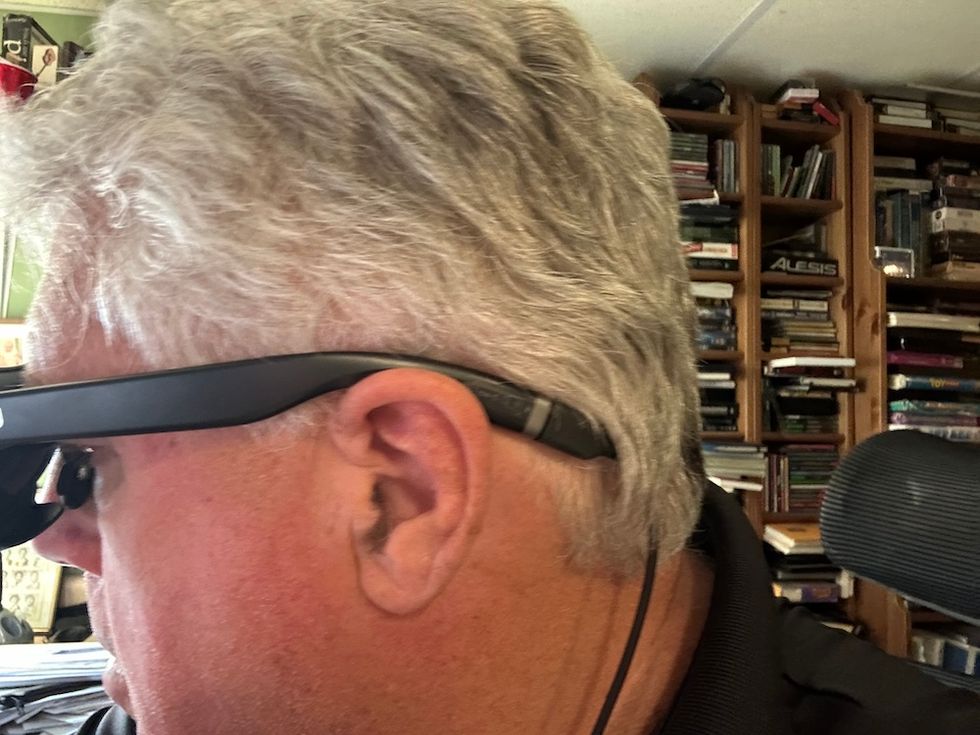
One of the first things I noticed was how lightweight the Max 2 feels.
At 75 grams, they're certainly heavier than ordinary sunglasses, but noticeably lighter than many AR glasses I've tested over the past several years.
After wearing them on an international flight to China, I found them comfortable enough for extended viewing sessions, although there is definitely an adjustment period.
Like most wearable displays, your brain needs a little time to adapt to watching a floating screen positioned several feet in front of you.
Once I became accustomed to wearing them, they felt natural during long movie sessions and work tasks.
The design is understated enough that you don't feel like you're wearing an oversized VR headset.
A Beautiful Display That Steals the Show
The display is where Rokid really shines.
The Max 2 features two Sony Full HD Micro OLED displays capable of producing:
- 120Hz refresh rate
- 600 nits brightness
- 100,000:1 contrast ratio
- 50° field of view
- Support for both 2D and 3D content
The result is one of the sharpest images I've seen from AR glasses.
Movies look vibrant.
Games appear incredibly smooth.
Text remains readable for productivity work.
The 120Hz refresh rate makes a noticeable difference, especially when gaming and watching action movies.
Motion feels fluid with very little blur, making fast-moving scenes much easier on your eyes than lower-refresh displays.
Built-In Myopia Adjustment Is a Game Changer
 Built-In Myopia Adjustment Is a Game ChangerGearBrain
Perhaps my favorite feature is something that doesn't receive nearly enough attention.
The Rokid Max 2 includes built-in myopia adjustment dials.
Instead of purchasing expensive prescription inserts—or constantly switching between glasses—you simply rotate physical adjustment wheels until the image becomes perfectly clear.
The glasses support vision correction from 0.00D to -6.00D.
It's one of the biggest quality-of-life improvements I've seen in AR glasses.
It also means multiple people in the same household can share the glasses without needing custom prescription inserts.
For anyone who wears glasses, this feature alone could justify choosing the Max 2 over competing AR displays.
Compatibility Is Excellent
Connected Max 2 to my MacBook Air laptop using the USB-C cordGearBrain
One reason I enjoyed using the Max 2 is its flexibility.
During testing, I connected it to:
- My MacBook Air
- Smartphones
- Gaming handhelds
- Multiple USB-C devices
It also supports:
- Xbox
- PlayStation 5
- Nintendo Switch
- Steam Deck
- ASUS ROG Ally
- iPhone 15 and newer
- Most Android phones
- USB-C laptops
Since it behaves like an external monitor, setup couldn't be easier.
Simply connect the USB-C cable, and the display appears almost instantly.
No applications.
No accounts.
No firmware headaches.
Just plug and play.
Perfect for Travel
My favorite use case turned out to be travel.
On my recent business trip to China, I watched movies on the Max 2 throughout the flight.
Instead of relying on the airplane entertainment system or staring at a small laptop screen, I genuinely felt like I was carrying my own private movie theater.
The virtual screen blocks many distractions around you while keeping you aware of your surroundings.
It's one of those products you don't fully appreciate until you actually travel with it.
Hotel rooms become home theaters.
Airport lounges become private cinemas.
Coffee shops become personal workstations.
Gaming Is Surprisingly Immersive
Gamers may be the biggest winners here.
Connecting the Max 2 to a Steam Deck dramatically changes the experience.
Instead of looking down at a handheld display, you're suddenly playing on what feels like a giant television.
The same is true for Xbox and PlayStation.
The 120Hz refresh rate, combined with the 50-degree field of view, creates a noticeably more immersive gaming experience than playing on smaller portable screens.
If you already own a handheld gaming PC, these glasses are worth serious consideration.
Where the Max 2 Falls Short
Birdbath lens effect on Max 2GearBrain
The biggest disappointment is the audio.
While the directional speakers are perfectly acceptable for casual viewing, they don't create the same immersive experience as the display itself.
The visuals are outstanding.
The sound is merely adequate.
For the best experience, I recommend pairing the Max 2 with wireless earbuds or quality headphones.
I also encountered something common among many birdbath-style AR displays.
Occasionally, I noticed reflections from my cheeks or eyebrows appearing near the borders of the display.
This phenomenon—known as the birdbath lens effect—occurs because light reflects internally within the optical system.
It wasn't constant, but I noticed it often enough to mention it for prospective buyers.
Fortunately, after extended use, I found myself focusing on the virtual screen rather than the reflections.
No Battery Means Less Hassle
Another feature I appreciate is what the Max 2 doesn't include.
There is no internal battery.
Instead, the glasses draw power directly from your connected device.
That means:
- No charging schedule
- No battery degradation
- No worrying about forgetting to recharge before a flight
For travel, simplicity matters.
The Max 2 embraces that philosophy.
Who Should Buy the Rokid Max 2?
After testing these glasses in multiple environments, I believe the ideal buyers are:
If your primary goal is watching movies, gaming, or creating a portable workstation, the Max 2 delivers an experience that few products currently match.
Who Should Skip It?
Volume buttons on the arm of the Max 2GearBrain
These aren't the right choice if you're looking for:
- AI-powered smart glasses
- Built-in cameras
- Spatial computing similar to Apple Vision Pro
- Rich, theater-quality audio
The Max 2 is designed as a premium wearable display—not an all-in-one AR computing platform.
Pros
- Outstanding Sony Micro OLED display
- Bright 600-nit image
- Smooth 120Hz refresh rate
- Excellent built-in myopia adjustment
- No prescription inserts required
- Lightweight 75g design
- Works with laptops, phones, consoles, and handheld gaming PCs
- Plug-and-play operation
- No batteries to charge
- Excellent value at current sale pricing
Cons
- Audio lacks immersion
- Birdbath lens reflections can occasionally appear
- Takes a little time to get accustomed to wearing
- Requires a compatible USB-C DisplayPort device
Final Verdict
The Rokid Max 2 succeeds because it doesn't try to do everything.
Instead, it focuses on delivering one of the best portable display experiences currently available.
The bright 120Hz Sony Micro OLED displays, wide 50-degree field of view, excellent compatibility, and innovative built-in myopia adjustment combine to create AR glasses that are genuinely practical for everyday use.
The current sale pricing makes the Max 2 even easier to recommend. At nearly 40% below its original MSRP, it offers exceptional value for travelers, gamers, and mobile professionals who want a giant private screen that fits inside a backpack. Pricing and promotions may change over time, but at today's sale prices, the Max 2 is one of the strongest values in portable AR displays.
GearBrain Review Score: 9/10
Bottom Line: If you're looking for a portable, private display for movies, work, and gaming rather than AI-powered smart glasses, the Rokid Max 2 is one of the best AR glasses you can buy today. Its superb display quality, built-in vision adjustment, broad compatibility, and significantly reduced price make it an easy recommendation for frequent travelers, gamers, and anyone who wants to carry a 215-inch screen wherever they go.
From Your Site Articles
Related Articles Around the Web

 Design and ComfortGearBrain
 Built-In Myopia Adjustment Is a Game ChangerGearBrain
 Connected Max 2 to my MacBook Air laptop using the USB-C cordGearBrain
 Birdbath lens effect on Max 2GearBrain
 Volume buttons on the arm of the Max 2GearBrain