Mini-split air conditioners and heat pumps are popular because they provide heating and cooling without requiring traditional ductwork. But many ductless systems still rely on handheld infrared remotes, making it difficult to control temperatures when you're away, create automated schedules, or integrate heating and cooling into your smart home.
Fortunately, smart mini-split controllers can add many of those capabilities without replacing your existing HVAC equipment.
Products from Mysa, Cielo, Sensibo, and Boldr promise to make ductless climate control more convenient. They offer combinations of smartphone control, temperature monitoring, scheduling, geofencing, and smart home integrations.
However, not every controller works with every mini-split, and support for Alexa, Google Home, Apple Home, Matter, or Samsung SmartThings can vary considerably.
That's why compatibility should be your first consideration when choosing a smart thermostat for a mini-split—not price or the number of advertised features.
In this buying guide, GearBrain compares four smart mini-split controllers, explains how they work, and helps you decide which features matter most before you buy.
Editor's Note: This is a research-based buying guide using published product information, not a hands-on performance test of all four controllers. Product capabilities, pricing, and supported integrations may change. Verify compatibility with your exact mini-split model before purchasing.
Quick Answer: Which Smart Thermostat Is Best for a Mini Split?
The best controller depends on your existing air conditioner, smart home ecosystem, and preferred features.
- Mysa for Mini-Splits: A strong option for homeowners who want a familiar thermostat experience and Apple Home integration.
- Cielo Breez Max: A compelling choice for users who want on-device controls, temperature and humidity automation, and multi-zone management features.
- Sensibo Air Pro: Worth considering if you want smart AC control combined with indoor air quality monitoring.
- Boldr Klima: An alternative for buyers who want design-focused climate control, provided you confirm the exact model's compatibility and integrations.
There is no universal winner. A controller that integrates with your existing smart home and correctly operates your particular mini-split is more valuable than one offering features you cannot use.
How Do Smart Thermostats Work With Mini-Split Air Conditioners?
Most conventional smart thermostats, including popular models from Nest and ecobee, are designed to communicate with compatible HVAC systems through low-voltage thermostat wiring.
Many ductless mini-splits operate differently.
Instead of relying on a traditional thermostat connection, they receive commands from an infrared remote.
A smart mini-split controller typically replaces the remote's everyday role by sending compatible infrared commands to the indoor unit.
The controller connects to your home Wi-Fi network, allowing you to manage supported functions through a smartphone app.
Depending on the device and air conditioner, these functions can include:
- Turning heating or cooling on and off
- Adjusting temperature settings
- Changing operating modes
- Controlling fan speeds
- Creating heating and cooling schedules
- Monitoring room temperature and humidity
- Using location-based automation
- Integrating climate control with smart home routines
The important distinction is that an infrared controller does not automatically give your mini-split every capability of a fully integrated smart HVAC system.
Available functions depend on the air conditioner, its infrared command set, and the controller's software.
Can Nest or ecobee Control a Mini Split?
Sometimes, but not necessarily through a direct connection.
Certain ductless HVAC systems can work with compatible thermostat interfaces or manufacturer-approved adapters that enable conventional low-voltage thermostat control.
Those installations may require professional assistance and can have limitations.
For many mini-splits operated by an infrared remote, a purpose-built smart AC controller is the simpler option.
Always check the HVAC manufacturer's requirements before installing a third-party thermostat or adapter.
4 Smart Thermostats for Mini Splits: Comparison Table
| Product | Key advantage | Smart home compatibility | Best suited for |
|---|
| Mysa for Mini-Splits | Familiar thermostat-style controls and scheduling | Apple Home, Alexa, Google Home; verify model | Apple-focused smart homes |
| Cielo Breez Max | On-device controls, comfort automation, multi-zone features | Alexa, Google, SmartThings, Siri Shortcuts, IFTTT | Households managing multiple ductless units |
| Sensibo Air Pro | Temperature, humidity, and air quality monitoring | Apple HomeKit, Alexa, Google, SmartThings; verify integration features | Buyers interested in climate and air quality data |
| Boldr Klima | Design-focused smart climate control | Confirm currently supported platforms and protocols | Buyers prioritizing aesthetics and supported automation |
Compatibility note: These integrations do not mean that every feature available in the manufacturer's app will also appear in Apple Home, Alexa, Google Home, or SmartThings. Matter support should be verified separately rather than inferred from another integration.
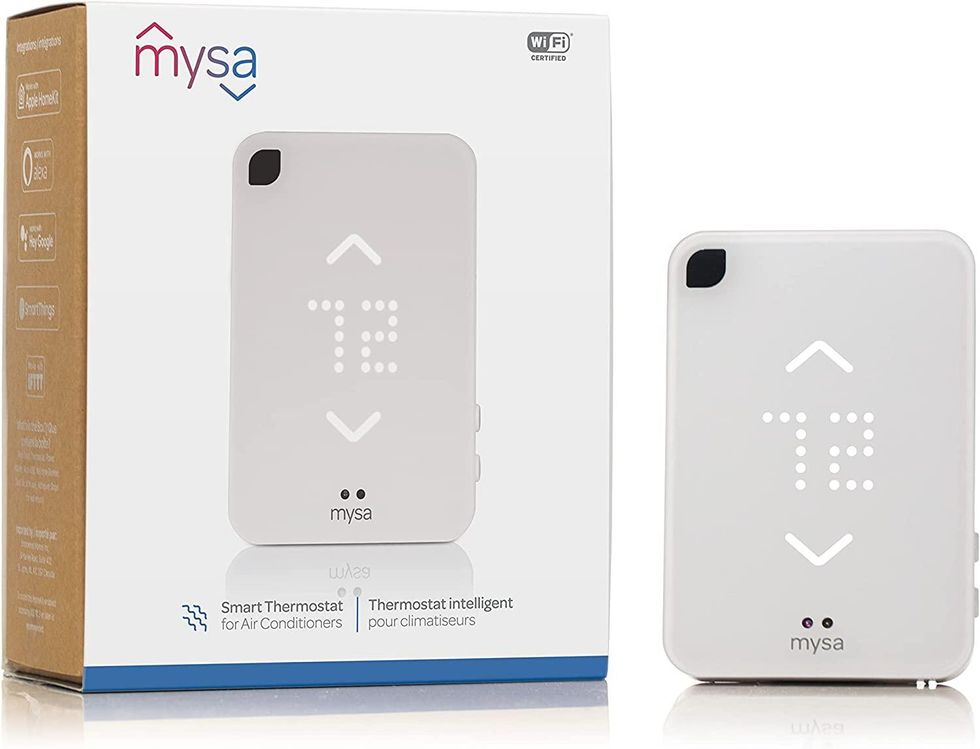
1. Mysa for Mini-Splits: Best for Apple Home Users
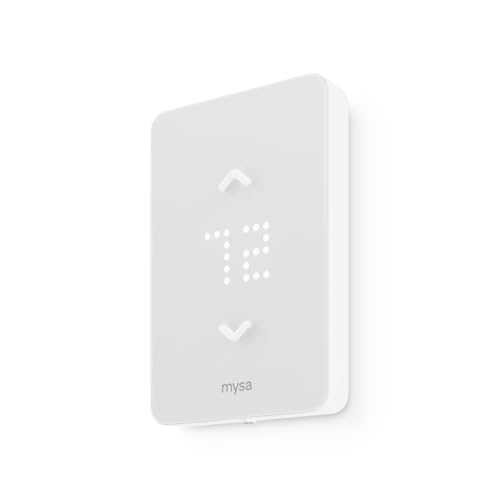
 Mysa Smart Thermostat Mysa
Mysa offers smart climate control products for different types of heating and cooling equipment.
Its mini-split controller works with compatible ductless air conditioners and heat pumps that use infrared remote controls.
Unlike a basic remote replacement, Mysa brings temperature management into a connected-home environment.
Key Features
Mysa's mini-split controller offers features such as:
- Smartphone-based temperature control
- Heating and cooling schedules
- Room temperature monitoring
- Smart home voice control
- Apple Home integration
- Automation options for managing comfort throughout the day
The main attraction is the combination of connected features and a recognizable thermostat experience.
Why Choose Mysa?
Mysa is particularly appealing for households that already use Apple Home devices.
For example, a homeowner might want to include a compatible mini-split in an evening routine alongside smart lights and other connected devices.
Instead of managing climate control through a separate handheld remote, supported commands can become part of the broader smart home experience.
What to Consider
Mysa is not a universal replacement for every ductless remote.
Buyers should verify their exact air conditioner model and supported commands before ordering.
They should also confirm they are buying the mini-split version of Mysa, not one of the company's products designed for electric baseboard heating or other HVAC applications.
GearBrain's assessment: Mysa is a strong candidate for homeowners who prioritize Apple Home compatibility and straightforward smart climate control.
2. Cielo Breez Max: Best for Advanced Climate Control and Multiple Zones
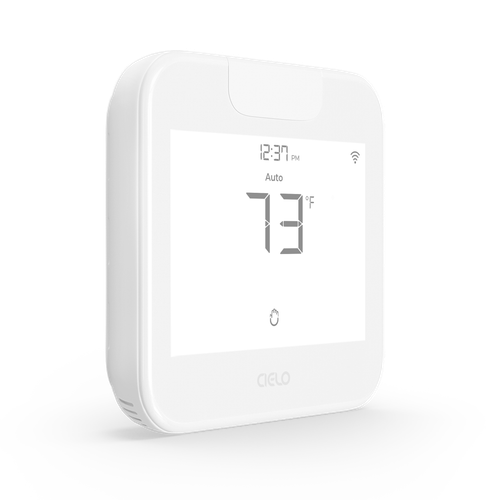
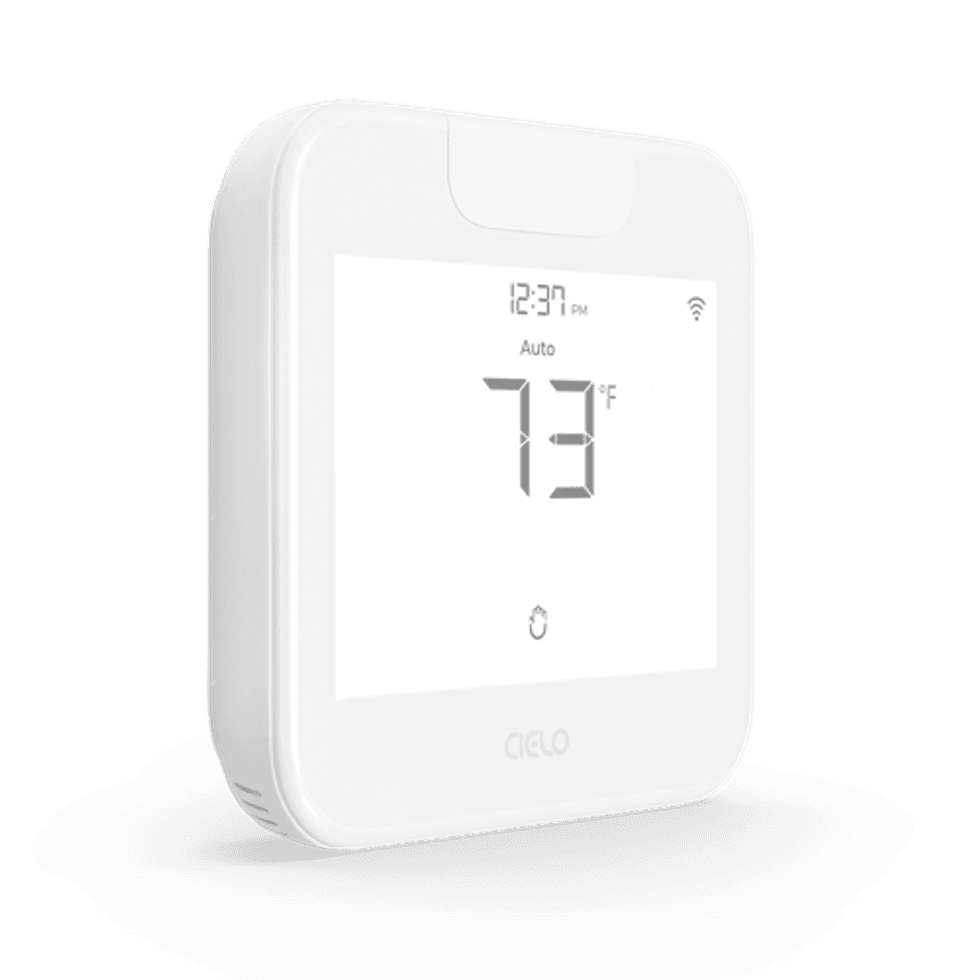
 Cielo Breez Max (White) Cielo Breez
Cielo Breez Max adds connected controls to compatible mini-splits, window air conditioners, portable AC units, and heat pumps that use infrared remotes.
Its combination of physical controls, room sensors, and app-based automation makes it especially useful for households with multiple ductless units.
Key Features
Cielo Breez Max includes:
- On-device temperature and mode controls
- Built-in temperature and humidity sensors
- Smartphone control through the Cielo Home app
- Weekly scheduling
- Geofencing
- Temperature- and humidity-based comfort automation
- Usage history
- Multi-zone management features
- Alexa and Google Assistant integrations
- Samsung SmartThings, Siri Shortcuts, and IFTTT support
One useful feature is Cielo's ability to help manage operating modes across compatible multi-zone mini-split installations.
This matters because some multi-zone heat pump systems cannot heat one room and cool another at the same time.
Why Choose Cielo Breez Max?
Cielo is worth considering when a household wants more than basic remote control.
For example, a homeowner with ductless units in several bedrooms may want separate temperature schedules while maintaining a coordinated view of the system.
Cielo's comfort automation can also respond to measured room conditions, reducing the need for repeated manual adjustments.
What to Consider
Siri Shortcuts support is not the same as native Apple Home compatibility.
Similarly, SmartThings compatibility doesn't automatically mean Matter support unless your SmartThings device is a Matter controller.
Although Cielo Breez Max has ENERGY STAR-listed model variants, buyers should check the exact model and certification rather than assuming that every Cielo product carries the same certification.
GearBrain's assessment: Cielo Breez Max offers an attractive mix of local controls, smart automation, and multi-zone functionality for users who want more detailed climate management.
3. Sensibo Air Pro: Best for Smart Climate Control and Air Quality Monitoring
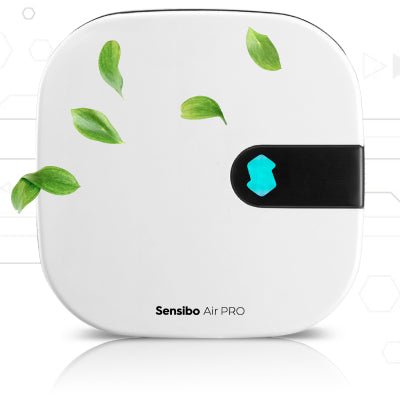
 Sensibo Air PRO Sensibo Air PRO
Sensibo Air Pro combines smart air conditioner control with environmental monitoring.
That makes it different from controllers focused primarily on temperature adjustment.
Beyond controlling compatible air conditioners and heat pumps, Sensibo Air Pro monitors room conditions that affect comfort.
Key Features
Sensibo Air Pro offers:
- Smartphone control
- Temperature and humidity monitoring
- Air quality monitoring
- Total volatile organic compound (TVOC) sensing
- Estimated CO2-equivalent information
- Scheduling and geofencing
- Climate-based automation
- Alexa and Google Assistant integration
- Apple HomeKit support
- Additional integrations, including SmartThings
The air quality features are the main differentiator.
For homeowners who want to monitor both room temperature and air quality, the extra monitoring can make Sensibo Air Pro more appealing than a basic infrared controller.
An Important Distinction About CO2 Monitoring
Sensibo describes its Air Pro as offering CO2-related air quality information. However, its published technical specifications identify a CO2-equivalent measurement derived from its sensing system.
That is not necessarily the same as measuring actual carbon dioxide concentration using a dedicated CO2 sensor.
Consumers who need accurate CO2 measurements for ventilation analysis should understand this distinction before purchasing.
Why Choose Sensibo Air Pro?
Sensibo Air Pro is a useful option for households that want to monitor indoor conditions alongside climate control.
For example, a homeowner might use its temperature, humidity, and air quality information to better understand how a room changes throughout the day.
The controller can also automate compatible air-conditioning functions based on schedules or occupancy settings.
What to Consider
Not every Sensibo feature is necessarily available through every connected smart home platform.
Some advanced software capabilities may also depend on an optional subscription.
Buyers should verify the included features, supported integrations, and any recurring costs.
GearBrain's assessment: Sensibo Air Pro is particularly interesting for users who want environmental monitoring in addition to conventional smart AC controls.
4. Boldr Klima: A Design-Focused Alternative for Mini-Split Control
 Boldr Klima Boldr Klima
Boldr Klima is another option for homeowners considering a dedicated controller for ductless heating and cooling.
Its appeal is its design-oriented approach to connected climate management.
If you prefer a visible, wall-mounted climate controller over a small infrared accessory, this type of product may be worth investigating.
What Buyers Should Evaluate
Before choosing Boldr Klima, we recommend confirming:
- Compatibility with the exact mini-split manufacturer and model
- Whether all required heating and cooling modes are supported
- The current smart home integrations
- Whether the specific product version supports Matter
- Whether Thread is supported, and for what purpose
- Available scheduling and automation features
- Installation and power requirements
- Warranty and software support
Does Boldr Klima Support Matter or Thread?
Matter and Thread are different technologies.
Matter is a smart home interoperability standard, while Thread is a networking technology that some Matter devices use.
Support for one does not imply support for the other.
For Boldr Klima, buyers should confirm the exact hardware version, firmware requirements, and supported Matter features before purchasing for a Matter-based smart home.
Why Choose Boldr Klima?
Boldr Klima may appeal to buyers who value a design-focused wall controller and want an alternative to more established smart AC accessories.
However, the decision should depend on verified compatibility and available functionality rather than design alone.
GearBrain's assessment: Boldr Klima is worth considering as an alternative, but we would not rank it ahead of the other controllers without independently confirming its current capabilities and testing it with a compatible mini-split.
Which Smart Thermostat Works With Your Mini Split?
 Mysa Smart Thermostat for Air Conditioners and mini split heaters, ductless heat pumps and portal AC units. Amazon
This is the most important question in the buying process.
Even if a controller advertises compatibility with thousands of air conditioners, that does not guarantee support for every model or function.
Before purchasing, check the following.
1. Identify Your Mini-Split Model
Find the manufacturer's name and exact model number of your indoor unit.
Do not rely solely on the brand name. Manufacturers may use different control systems across product families.
2. Check the Existing Remote
Many smart mini-split controllers are designed for systems that use infrared remotes.
If your system uses a proprietary wired controller, radio-frequency remote, or manufacturer-specific communication interface, a conventional infrared controller may not be suitable.
3. Verify Supported Functions
Check whether the controller supports the functions you use regularly.
These may include heating, cooling, automatic mode, fan speeds, vane movement, and special operating modes.
A controller may successfully turn on an air conditioner without supporting every command available on its original remote.
4. Check Your Smart Home Ecosystem
Determine whether the product supports your preferred platform.
For example, Apple Home users should look for explicitly documented Apple Home compatibility rather than assuming Siri Shortcuts offer the same functionality.
Similarly, buyers using Matter should confirm Matter support for the exact controller.
5. Check Your Wi-Fi Network
Many smart AC controllers use 2.4GHz Wi-Fi.
Before installing one, make sure your network provides adequate coverage and that the controller can connect using the supported Wi-Fi security and configuration settings.
6. Plan Controller Placement
Infrared controllers generally need a suitable path for their signals to reach the indoor unit.
Placing a controller behind furniture, inside a cabinet, or too far from the air conditioner may affect reliability.
A multi-room home will generally need a separate infrared controller for each indoor unit.
Do Smart Mini-Split Controllers Work With Matter?
Matter is designed to improve interoperability among supported smart home devices and platforms.
However, not every smart thermostat or air conditioner controller supports Matter.
It is important to distinguish among:
- Native Matter compatibility
- Native Apple Home compatibility
- Alexa or Google Assistant integrations
- Samsung SmartThings integrations
- Siri Shortcuts
- Third-party bridges or hubs
These are not interchangeable.
A controller that works with Alexa does not automatically work with Matter. Likewise, Apple HomeKit support does not automatically mean that a device uses Matter.
Consumers building a Matter-based smart home should verify the product's current certification and the specific controls exposed through Matter.
Can Smart Mini-Split Controllers Reduce Energy Bills?
Smart controllers can help households manage heating and cooling more consistently.
Schedules, geofencing, temperature limits, and automation may reduce unnecessary operation.
For example, a household might schedule a mini-split to operate differently during work hours or use a location-based routine to adjust settings when everyone leaves.
However, actual energy savings depend on several factors:
- The efficiency of the existing mini-split
- Local weather conditions
- Insulation and room size
- Occupancy patterns
- Existing thermostat habits
- The automation settings used
- Heating and cooling demand
A controller does not automatically make the underlying HVAC equipment more efficient.
We would therefore avoid assuming that any of these devices will pay for itself within a particular period.
Consumers should evaluate the convenience and automation benefits alongside any potential reduction in energy consumption.
What About Installation?
Most infrared smart AC controllers do not require replacing the mini-split's internal electronics or rewiring its thermostat connections.
The typical installation process involves:
- Confirming that the controller supports the air conditioner.
- Connecting the controller to its required power source.
- Installing the manufacturer's smartphone app.
- Connecting the device to Wi-Fi.
- Pairing or configuring the air conditioner.
- Testing heating, cooling, temperature, and fan commands.
- Connecting supported smart home platforms.
- Creating schedules and automations.
Installation requirements vary by product.
Some controllers sit on a shelf, while others can be wall-mounted or use alternative power arrangements.
Always follow the manufacturer's instructions.
Which Smart Thermostat Should You Buy?
For most consumers, the best choice depends on what matters most.
Choose Mysa if: You want familiar thermostat-style controls and are building around Apple Home or another supported voice assistant.
Choose Cielo Breez Max if: You want extensive comfort automation, on-device controls, and features designed for managing multiple ductless units.
Choose Sensibo Air Pro if: You want smart air-conditioning controls plus temperature, humidity, and air-quality monitoring.
Consider Boldr Klima if: You prefer its design and have verified that its hardware, software, and supported integrations meet your requirements.
Before purchasing any controller, verify compatibility with your mini-split and your existing smart home devices.
Frequently Asked Questions
What is the best smart thermostat for a mini split?
No single option is best for every mini-split. Mysa, Cielo Breez Max, and Sensibo Air Pro each offer different strengths, while Boldr Klima may appeal to buyers who want a design-focused alternative. The best choice depends on your exact HVAC model and preferred smart home platform.
Can you use a regular smart thermostat with a mini split?
Some mini-splits can work with conventional thermostats through compatible interfaces or adapters. However, many ductless systems use infrared remotes, so dedicated smart AC controllers are often a simpler solution.
Do smart mini-split controllers require professional installation?
Many infrared controllers can be installed without changes to HVAC wiring. Systems requiring a thermostat interface, electrical modifications, or specialized integration may need professional installation.
Can you control multiple mini-splits with one smart thermostat?
An infrared controller generally operates one indoor unit. Multiple rooms typically need multiple controllers, though a manufacturer's app may let you manage them together.
Do mini-split smart thermostats work with Apple Home?
Some do. Mysa for Mini-Splits and Sensibo Air Pro support Apple Home. Other products may provide Siri Shortcuts or different integrations that should not be confused with native Apple Home support.
Do these controllers support Matter?
Matter support varies by product and hardware version. Do not assume that Alexa, Google Home, Apple HomeKit, or SmartThings compatibility establishes native Matter support.
Do smart mini-split controllers need a subscription?
Many basic remote-control and scheduling features are available without recurring fees, but some manufacturers offer optional paid features. Check the current plan details before purchasing.
Can a smart thermostat lower my mini-split's electricity use?
Scheduling, geofencing, and temperature automation may help reduce unnecessary heating or cooling. Savings are not guaranteed and depend on the equipment, environment, and household habits.
GearBrain's Final Verdict
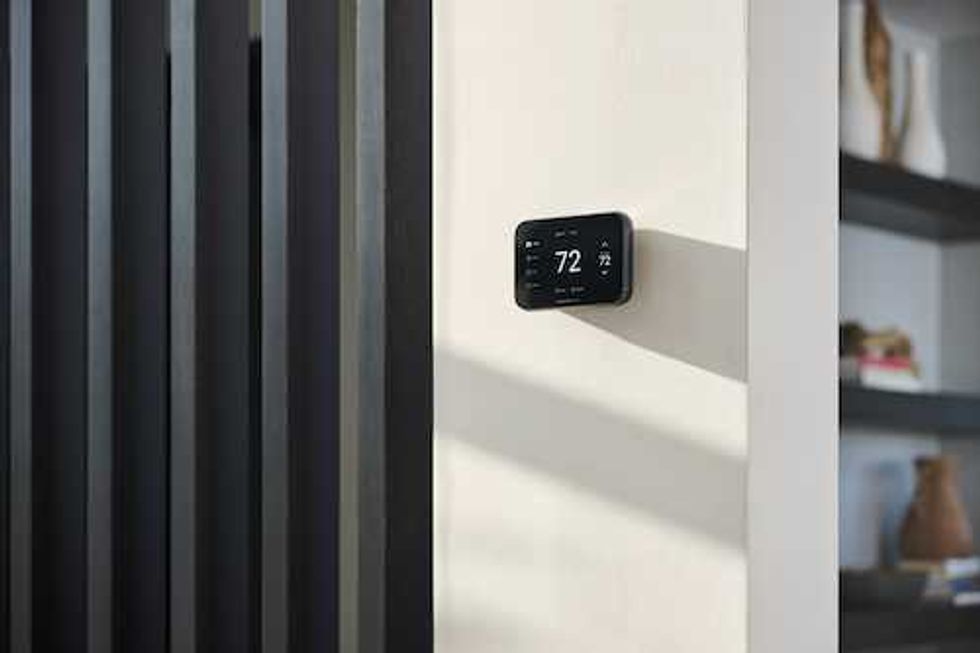
 Can a smart thermostat lower my mini-split's electricity use? Resideo
Smart thermostats and infrared controllers can make ductless mini-split systems easier to manage and more useful within a connected home.
They can add smartphone access, voice control, scheduling, and automation to equipment that might otherwise rely on a traditional handheld remote.
Among the four options compared, Mysa is a compelling choice for Apple Home users, Cielo Breez Max offers extensive climate management features, and Sensibo Air Pro adds an interesting environmental monitoring component.
Boldr Klima offers another option, but you should verify its current smart home integrations and compatibility before buying.
But the most important takeaway is simple:
The best smart thermostat for your mini split is the one that works reliably with your air conditioner and the smart home devices you already own.
Before buying, check your indoor unit's exact model number, remote-control technology, Wi-Fi requirements, and supported smart home integrations.
GearBrain's mission is to help consumers find, buy, connect, and manage smart devices that work together. Use the GearBrain Compatibility Find Engine and GearBrain Assistant to research connected devices, explore smart home options, and confirm model-specific HVAC compatibility with the controller manufacturer.
The right controller can turn a conventional ductless air conditioner into a more convenient part of your smart home—without replacing the HVAC system itself.
 Mysa Smart Thermostat Mysa
 Cielo Breez Max (White)

 Sensibo Air PRO

 Boldr Klima

 Mysa Smart Thermostat for Air Conditioners and mini split heaters, ductless heat pumps and portal AC units. Amazon
 Can a smart thermostat lower my mini-split's electricity use? Resideo